
Introduction
The Lesser Yellownape (Picus chlorolophus) is a captivating species of woodpecker that belongs to the Picidae family. Renowned for its striking plumage and distinct vocalizations, this bird is a classic representative of the tree-clinging guild found throughout the forests of South and Southeast Asia. Measuring approximately 25 to 27 centimeters in length, the Lesser Yellownape is a medium-sized bird that commands attention with its vibrant green body and signature yellow crest. As an arboreal specialist, it spends the vast majority of its life navigating the trunks and branches of trees, utilizing its specialized anatomy to probe for insects and communicate with its peers. Ornithologists and bird enthusiasts alike admire this species for its ecological role as an insect controller and its ability to thrive in diverse woodland environments. Understanding the Lesser Yellownape requires an appreciation for its complex behaviors, ranging from its rhythmic drumming on wood to its intricate nesting habits. This guide provides a comprehensive overview of this remarkable avian species, offering insights into its life cycle, physical traits, and the conservation efforts required to ensure its continued survival in the wild.
Physical Appearance
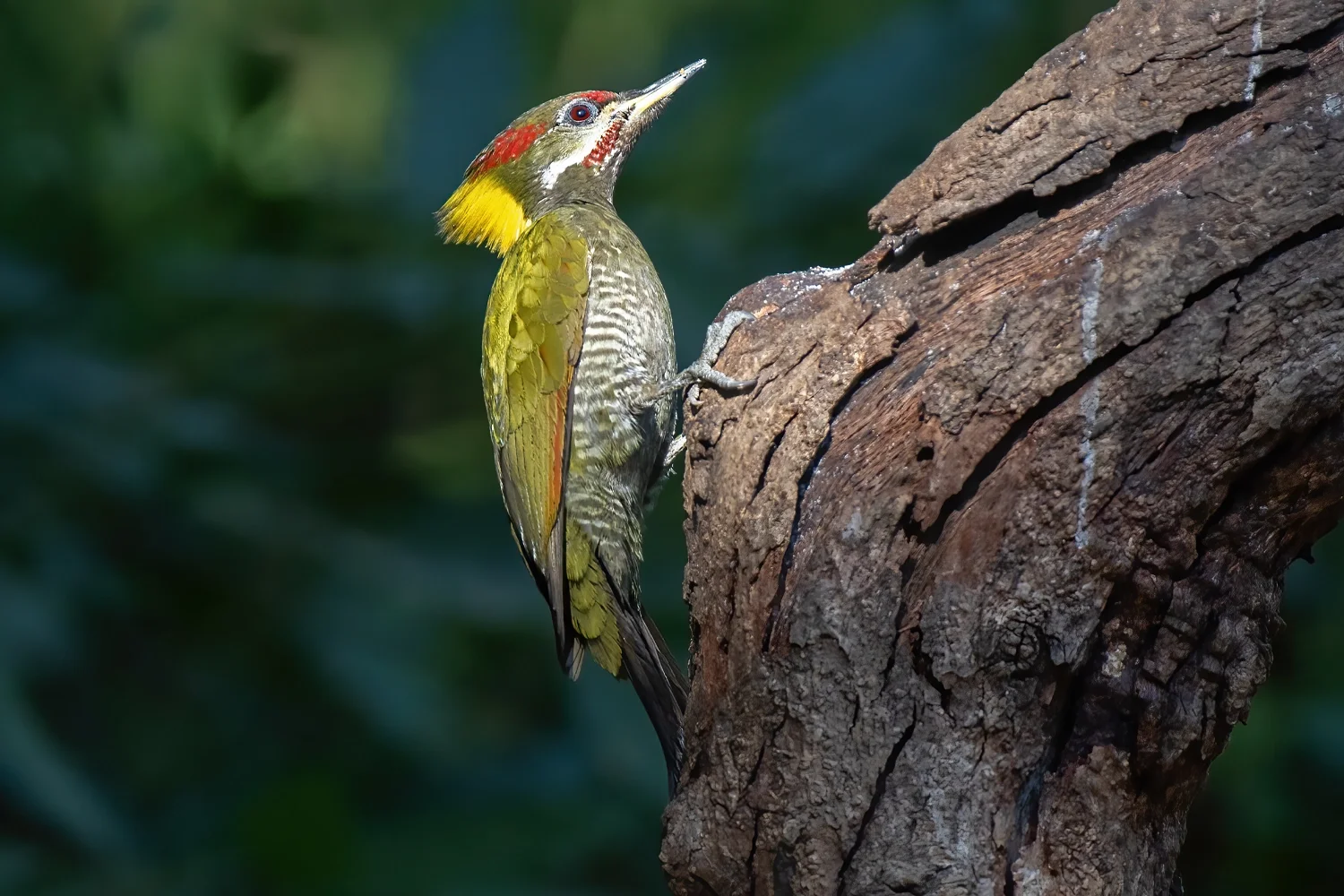
The Lesser Yellownape is visually distinct, characterized primarily by its beautiful, camouflaging olive-green plumage which allows it to blend seamlessly into the forest canopy. The most defining feature, which gives the bird its common name, is the brilliant yellow nape or crest that stands out against its darker, greenish-brown head. Both males and females exhibit this coloration, though there are subtle sexual dimorphic traits that allow observers to distinguish between the two. Males often possess a more pronounced crimson patch on the malar region or forehead, whereas females may lack this intensity or feature different markings. The bird features a sturdy, chisel-like bill perfectly adapted for excavating wood and searching for prey. Its body is streamlined and compact, reflecting its evolution as a climber. The tail feathers are stiff and pointed, acting as a prop or support while the bird clings vertically to tree trunks, a hallmark trait of the Picidae family. The legs are short but powerful, equipped with zygodactyl feet—two toes forward and two toes backward—providing the necessary grip for vertical movement. This combination of structural adaptations makes the Lesser Yellownape a master of its arboreal domain.
Habitat
The Lesser Yellownape is widely distributed across the Indian subcontinent and parts of Southeast Asia. It prefers a variety of forested habitats, showing a particular affinity for moist deciduous forests, evergreen forests, and secondary growth woodlands. These birds are frequently found in hilly terrain and are known to inhabit elevations ranging from the lowlands up to the foothills of the Himalayas. They rely on mature trees with soft or decaying wood, which are essential for both foraging and nest excavation. Unlike some deep-forest specialists, the Lesser Yellownape is somewhat adaptable and can occasionally be spotted in plantations, orchards, and wooded gardens near human settlements, provided there is sufficient tree cover and a steady food supply.
Diet
As an insectivorous bird, the Lesser Yellownape plays a vital role in forest health by regulating insect populations. Its primary diet consists of ants, termites, beetle larvae, and various other wood-boring insects. It uses its powerful bill to hammer and probe into the bark of trees, exposing hidden galleries where insects reside. Once the prey is located, the bird utilizes its long, sticky, and barbed tongue to extract the insects from deep within the wood. In addition to its primary insect diet, the Lesser Yellownape has been observed consuming small amounts of fruit, berries, and occasionally nectar, especially when insect availability fluctuates seasonally or during lean periods in the forest cycle.
Breeding and Nesting
The breeding season of the Lesser Yellownape typically aligns with the warmer months, often following the monsoon period when insect abundance is at its peak. Both the male and female participate in the labor-intensive process of excavating a nesting hole. They typically choose a dead or decaying tree trunk, often high above the ground, to protect their brood from terrestrial predators. The nest cavity is carefully hollowed out, with no additional nesting material added inside. A typical clutch consists of two to four white, glossy eggs. Both parents share the responsibility of incubation and subsequent chick rearing. The chicks are altricial, meaning they are born blind and helpless, requiring constant feeding and protection from their parents until they are ready to fledge. This cooperative parenting strategy ensures a higher rate of survival for the offspring in the challenging forest environment.
Behavior
The Lesser Yellownape is a solitary or pair-living bird, rarely seen in large flocks. It is most active during the early morning and late afternoon, periods characterized by frequent calling and foraging. The bird is known for its loud, ringing calls, which serve to mark territory and maintain contact with mates. When moving along tree trunks, it employs a jerky, upward motion, using its tail as a brace. Though they are not migratory, they may exhibit local movements in search of food. They are generally shy and often retreat to the opposite side of a tree trunk when approached, making them a challenging but rewarding subject for observant birdwatchers.
Conservation Status - LC Least Concern
Currently, the Lesser Yellownape is classified as a species of Least Concern by the IUCN. While its population appears to be stable, it is not immune to the threats posed by habitat loss and deforestation. As a species that relies on mature and decaying trees for nesting, the removal of deadwood from forests poses a significant risk to its reproductive success. Protecting old-growth forest tracts and encouraging sustainable forestry practices are essential for the long-term conservation of this bird, ensuring that it continues to thrive in its natural range across Asia.
Interesting Facts
- The Lesser Yellownape uses its stiff tail feathers as a 'third leg' for stability while climbing.
- Their tongue can extend significantly beyond the tip of their bill to reach deep inside tree crevices.
- They possess a spongy, shock-absorbing skull structure that protects their brain during rapid, high-impact drumming.
- The yellow crest is often raised when the bird is excited or agitated.
- They are highly territorial and will defend their chosen tree against other woodpecker species.
Tips for Birdwatchers
To spot the Lesser Yellownape, patience and silence are your best tools. Focus your search in wooded areas or forest edges during the early morning hours when these birds are most vocal. Listen for their distinct, ringing calls and the rhythmic sound of wood drumming, which will help you pinpoint their location. Once you hear them, scan the trunks of large, mature trees, especially those showing signs of decay. Using high-quality binoculars or a spotting scope is recommended as they are often shy and will move to the far side of a branch if they detect movement. Patience will eventually reward you with a view of this beautiful, green-clad avian wonder.
Conclusion
The Lesser Yellownape serves as a wonderful reminder of the hidden beauty found within our forest ecosystems. As a specialized tree-clinging bird, it occupies a unique niche that contributes to the overall health and vitality of the woodland environment. Through its insect-foraging habits, it acts as a natural pest control agent, while its nesting behaviors highlight the importance of preserving old-growth trees. For birdwatchers and nature enthusiasts, the opportunity to observe this species in its natural habitat is a testament to the rewards of patient observation and a deep appreciation for biodiversity. As we look toward the future, it is imperative that we continue to support conservation initiatives that protect the habitats of such charismatic species. By safeguarding the forests of Asia, we ensure that the Lesser Yellownape—and the myriad of other creatures that share its home—will continue to grace our world with their presence for generations to come. Whether you are a seasoned ornithologist or a casual backyard birder, the Lesser Yellownape remains a species truly worthy of our study, admiration, and protection.