Introduction
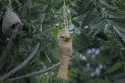
The Baya Weaver (Ploceus philippinus) is one of nature's most skilled architects. Found across the Indian Subcontinent and Southeast Asia, these social perching birds are celebrated for their incredible engineering skills. Known for creating complex, retort-shaped hanging nests, the Baya Weaver is a common sight in grasslands and agricultural areas, where they thrive in large, vocal flocks.
Physical Appearance
The Baya Weaver is a small bird, typically measuring between 15-15 cm. Their appearance changes drastically during the breeding season, particularly in males:
- Breeding Male (Nominate): Features a brilliant yellow crown, dark brown ear-coverts and throat, and an unstreaked yellow breast.
- Breeding Male (burmanicus): This subspecies found in the Northeast has a grayer face and a buff or pale gray throat.
- Non-breeding Male, Female, and Juveniles: Generally have unstreaked buffish underparts and lack the bright yellow patches, appearing more like sparrows with a buffish supercilium.
- Subspecies Variations: The travancoreensis subspecies in southwest India is known for being darker on its upper parts.
Habitat
Baya Weavers are highly adaptable but prefer specific environmental features for nesting and foraging:
- Grasslands and Scrub: They are most commonly found in open grasslands and secondary growth areas.
- Agricultural Land: They frequently inhabit cultivated areas like rice paddies and wheat fields.
- Proximity to Water: Colonies are often established near water sources or hanging directly over water to deter predators.
- Thorny Trees: They prefer nesting in thorny trees or palm fronds for added protection.
Diet
These birds have a diverse diet that ranges from agricultural crops to small proteins:
- Grains and Seeds: They feed heavily on rice, wheat, maize, sorghum, millet, and sunflowers.
- Wild Forage: Various wild grass-seeds are a staple part of their diet.
- Insects: They consume grasshoppers, flies, termites, beetles, caterpillars, and butterflies.
- Small Prey: Occasionally, they feed on spiders, small snails, and even small rice frogs.
- Nectar: They are known to supplement their diet with nectar from flowers.
Breeding and Nesting
The breeding season is the most active time for the Baya Weaver, showcasing their unique social structure:
- Masterful Construction: Males weave elaborate, retort-shaped nests using long strips of leaves and grass.
- Colonial Nesters: They build their nests in colonies, often with dozens of nests hanging from the same tree.
- Female Choice: Females inspect the partially finished nests built by males before choosing a mate based on the quality of the construction.
- Polygyny: A successful male may build several nests and mate with multiple females in a single season.
Behavior
Baya Weavers are highly social birds that are almost always seen in flocks. They are known for their local and seasonal movements, which are dictated by the onset of rain and the availability of food. During the breeding season, the colonies become a hub of activity with males constantly fluttering and chirping to attract females. Their flight is strong and direct, typical of most weaverbirds.
Conservation Status - LC Least Concern
The Baya Weaver is currently classified as Least Concern by the IUCN. They are widespread and common throughout their range. Because they have adapted well to human-modified landscapes and agricultural fields, their population remains stable, although they are sometimes considered a pest by farmers due to their preference for grain crops.
Interesting Facts
- Baya Weavers use their beaks like needles to weave intricate knots into their nests.
- The nests often have a long entrance tube to prevent predators like snakes from reaching the eggs.
- Males are the sole architects; females only join to help with the interior lining once they accept the nest.
- They sometimes use blobs of mud inside the nest, which scientists believe helps stabilize the structure against wind.
- There are five recognized subspecies of Baya Weaver across Asia.
- The birds are known to follow the rhythm of the monsoons for their breeding cycle.
Tips for Birdwatchers
To spot a Baya Weaver, head to wetlands or agricultural edges during the early morning. Look for hanging structures in acacia or palm trees, especially those near ponds or canals. During the monsoon season, you can easily identify breeding males by their bright yellow "caps." Listen for their distinct continuous chirping and buzzing sounds, which usually indicate a nearby colony.
Conclusion
The Baya Weaver is a testament to the incredible ingenuity of the avian world. From their complex social structures to their status as nature's master weavers, these birds are a delight for any birdwatcher or nature enthusiast. Whether you are admiring their golden plumage or their architectural wonders, the Baya Weaver remains one of the most fascinating species found in the Asian landscape.