
Introduction
The Barred Buttonquail (Turnix suscitator) is a small, ground-dwelling bird species found across South and Southeast Asia. Despite its name and resemblance to true quails, it belongs to a distinct family. This fascinating bird is well-known among birders for its unique social structure and secretive nature in the wild.
Physical Appearance
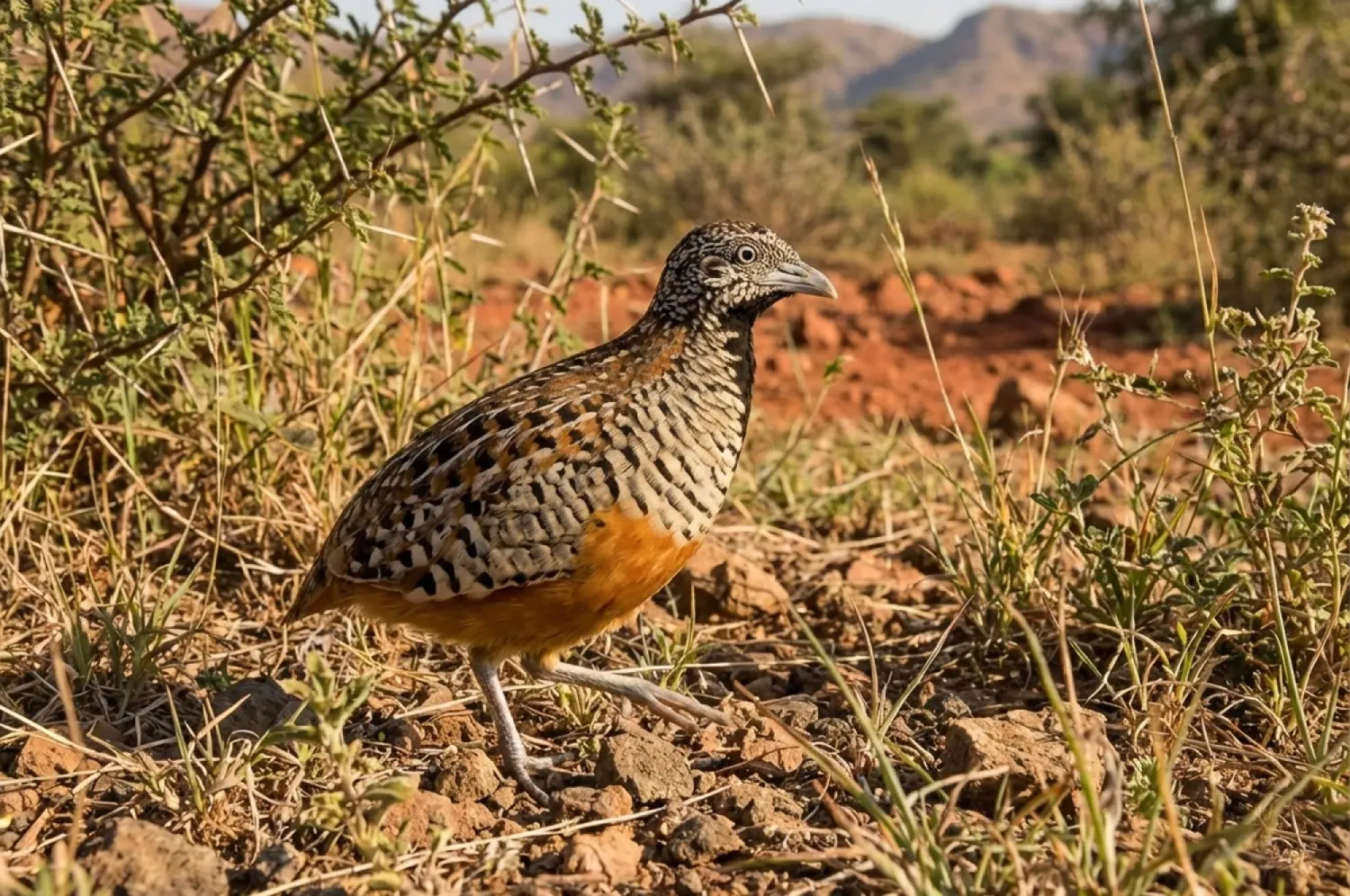
Measuring between 15-17 cm, the Barred Buttonquail features a compact body with a short tail and a relatively large head. It is characterized by heavy black barring on the throat and breast. In a reversal of typical avian roles, females are larger and more brightly colored than males, often displaying a distinct black patch on the throat and breast during the breeding season.
Habitat
These birds primarily inhabit scrublands, grasslands, and agricultural areas. They prefer low-lying regions with dense ground cover, such as forest edges, bushy gardens, and fallow fields, where they can easily hide from predators while foraging.
Diet
The Barred Buttonquail is an omnivore with a diet focused on the ground level. Its food consists mainly of seeds, small insects, and invertebrates. They are often seen scratching the soil and leaf litter to uncover termites, ants, beetles, and various plant materials.
Breeding and Nesting
The breeding system of the Barred Buttonquail is polyandrous. The female takes the lead in courtship, defending a territory and mating with multiple males. She leaves the responsibility of incubation and chick-rearing entirely to the males. The nest is typically a simple scrape on the ground, cleverly hidden under dense vegetation or grass.
Behavior
This species is highly terrestrial and secretive. They are reluctant fliers, preferring to run through the undergrowth when threatened. They are most active during the early morning and late afternoon, and they are more often heard than seen due to their excellent camouflage.
Conservation Status - LC Least Concern
The Barred Buttonquail is currently classified as Least Concern by the IUCN. While the species is widespread and the population is generally stable, they face localized threats from habitat loss due to rapid urbanization and intensive agricultural expansion.
Interesting Facts
- Unlike most bird species, the female Barred Buttonquail is more aggressive and colorful than the male.
- They belong to the family Turnicidae, which is evolutionarily closer to shorebirds and gulls than to true quails.
- The female produces a low, booming 'drrr-drrr' sound to attract mates and establish territory.
- The chicks are precocial, meaning they are born with feathers and can follow the male parent shortly after hatching.
Tips for Birdwatchers
- Listen for their low-frequency booming calls in the early morning to pinpoint their location.
- Check the edges of dirt tracks and footpaths near scrubby vegetation where they might emerge to forage.
- Move slowly and quietly; these birds are very shy and will freeze or run at the slightest disturbance.
- Use a spotting scope or high-quality binoculars to scan the ground at the base of bushes.
Conclusion
The Barred Buttonquail is a remarkable example of nature's diversity, particularly regarding its reversed gender roles and unique breeding habits. For any birdwatcher in Asia, catching a glimpse of this elusive and beautifully patterned bird is a true highlight of the field experience.