
Introduction
The Temminck's Stint (Calidris temminckii) is a diminutive wader belonging to the sandpiper family. Named after the Dutch naturalist Coenraad Jacob Temminck, this small bird is a frequent sight across Eurasia during its migratory cycles. Despite its small size, it is a hardy traveler and a fascinating subject for birdwatchers worldwide.
Physical Appearance
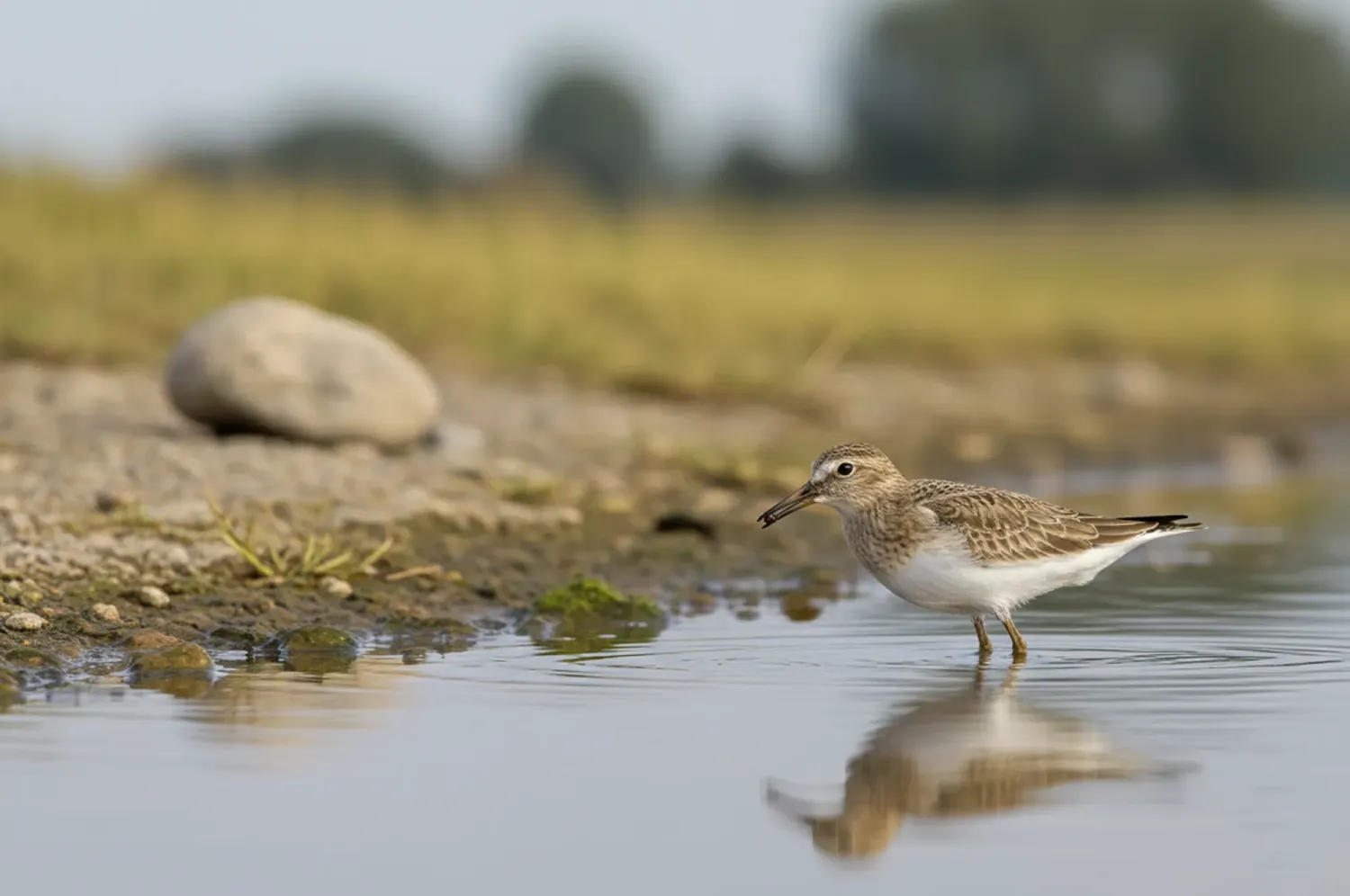
Measuring approximately 13-15 cm in length, the Temminck's Stint is characterized by its short, dark bill and relatively short, yellowish or greenish legs, which distinguish it from the black-legged Little Stint. Its plumage is generally a drab grayish-brown on the upperparts and white underneath, providing excellent camouflage against muddy backgrounds.
Habitat
The Temminck's Stint breeds in the tundra and boreal zones of northern Eurasia, often near water bodies with low vegetation. During the non-breeding season, it migrates to tropical Africa and southern Asia, where it prefers inland freshwater habitats, such as muddy lake shores, marshes, and riverbanks, rather than open coastal mudflats.
Diet
The diet of the Temminck's Stint primarily consists of insects and their larvae, which it picks from the surface of the mud or water. They also consume small crustaceans, mollusks, and occasionally seeds. Their foraging behavior is often described as 'mouse-like' as they creep slowly along the ground.
Breeding and Nesting
This species is famous for its unique double-clutching breeding system. A female often mates with two different males in quick succession, laying one clutch of eggs for the first male to incubate and a second clutch for herself or a second male. The nest is a simple scrape on the ground, usually hidden among short grass or scrub.
Behavior
Unlike many other stints, the Temminck's Stint is often quite solitary or found in small groups. When disturbed, it tends to tower into the air with a distinctive, high-pitched trilling call. Its flight is fast and erratic, often featuring a rapid zig-zag pattern to evade predators.
Conservation Status - LC Least Concern
The Temminck's Stint is currently classified as Least Concern by the IUCN. While its population is vast and its range is extensive, it remains sensitive to the loss of wetland habitats and the impacts of climate change on its arctic breeding grounds.
Interesting Facts
- It is named after the 19th-century Dutch zoologist Coenraad Jacob Temminck.
- Unlike most shorebirds, it prefers freshwater environments over saltwater estuaries during migration.
- The species exhibits a rare 'bigamous' mating system where both parents may incubate separate nests.
- Its trilling song is often compared to the sound of a grasshopper or a cricket.
Tips for Birdwatchers
- Check the legs: Always look for the yellowish-green leg color to avoid confusion with the Little Stint.
- Listen for the call: Their high-pitched 'tirrr' call is a key identifier during flight.
- Look inland: During migration, search for them at inland sewage farms or small freshwater ponds rather than coastal beaches.
- Watch the movement: Note their hunched, creeping posture while foraging, which is very different from the active 'stitching' motion of other sandpipers.
Conclusion
The Temminck's Stint is a subtle yet remarkable member of the wader family. From its complex social structures during the breeding season to its incredible transcontinental migrations, it remains a highlight for any birdwatcher exploring inland wetlands. Protecting its diverse habitats is essential for ensuring this small traveler continues its journey for generations to come.