
Introduction
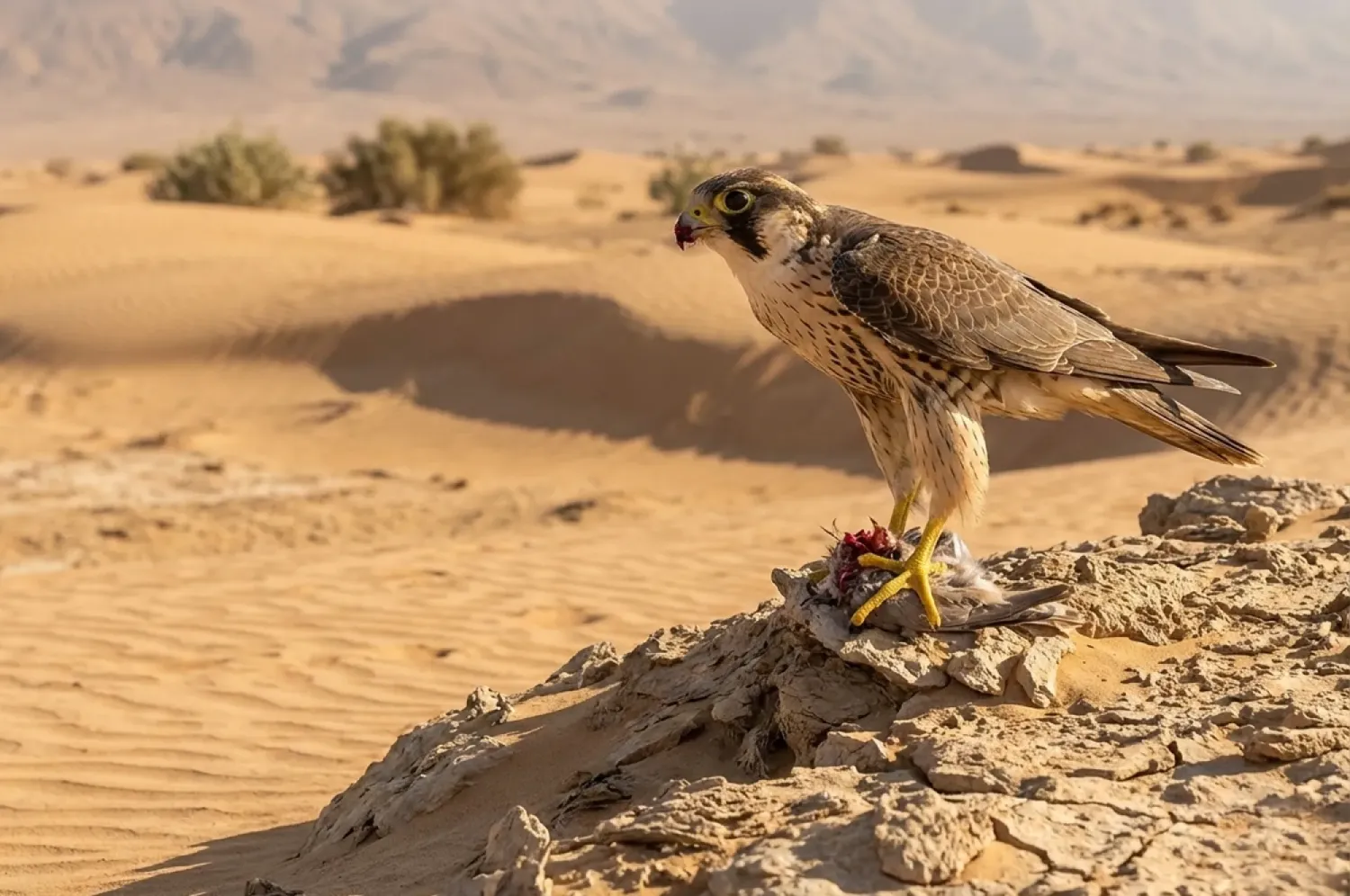
The Barbary Falcon (Falco pelegrinoides) is a powerful and medium-sized bird of prey. Frequently compared to the Peregrine Falcon, this raptor is a specialist of the desert, renowned for its incredible aerial agility and high-speed hunting dives in some of the harshest environments on Earth.
Physical Appearance
Measuring between 33-44 cm in length, the Barbary Falcon is slightly smaller and more slender than the common Peregrine Falcon. It is characterized by its paler upperparts, a distinct reddish or buff-colored patch on the nape, and a thinner black 'mustache' stripe on its face. Its wingspan typically ranges from 76 to 102 cm.
Habitat
The Barbary Falcon thrives in arid and semi-desert regions. They are most commonly found in areas with high cliffs, deep canyons, and mountain ranges across North Africa, the Middle East, and parts of Central Asia. They prefer open landscapes that provide clear visibility for hunting.
Diet
The diet of the Barbary Falcon consists almost exclusively of birds. They are apex predators of the sky, frequently preying on pigeons, doves, sandgrouse, and swifts. Like other large falcons, they capture their prey in mid-air through spectacular high-speed stoops.
Breeding and Nesting
These falcons typically nest on cliff ledges or in crevices. They do not build traditional nests but rather use a simple 'scrape' in the dirt or debris. A female will lay a clutch of 2 to 5 eggs, which are incubated for approximately 28 to 32 days.
Behavior
Barbary Falcons are highly territorial and diurnal hunters. They are known for their aggressive defense of nesting sites and their breathtaking flight displays. They spend much of their day perched on high vantage points scanning the horizon for potential prey.
Conservation Status - LC Least Concern
The Barbary Falcon is currently categorized as Least Concern by the IUCN. While their populations are generally stable, they are occasionally threatened by habitat degradation, the use of pesticides, and illegal poaching for the falconry trade.
Interesting Facts
- The species name 'pelegrinoides' literally means 'peregrine-like,' reflecting its close relationship with the Peregrine Falcon.
- It is considered one of the fastest animals in desert environments, capable of reaching speeds over 200 km/h during a dive.
- They are better adapted to heat than the Peregrine Falcon, allowing them to inhabit much hotter, drier climates.
- Taxonomists often debate whether it is a separate species or a subspecies of the Peregrine Falcon.
Tips for Birdwatchers
- Focus your search on high rocky outcrops and desert cliffs during the early morning or late afternoon.
- Look for the reddish nape patch, which is the primary field mark distinguishing it from the Peregrine.
- Use a high-magnification spotting scope to observe them while they are perched on distant cliff faces.
Conclusion
The Barbary Falcon is a magnificent example of avian adaptation. As a master of the desert winds, it remains a bucket-list species for birdwatchers and a vital part of the ecological balance in arid regions across the globe.
