
Introduction
The Bulwer's petrel (Bulweria bulwerii) is a fascinating, small seabird belonging to the family Procellariidae. Named after the English naturalist James Bulwer, this highly pelagic species is known for its graceful flight and elusive nature, spending the majority of its life far out at sea across the tropical and subtropical regions of the Atlantic, Indian, and Pacific oceans.
Physical Appearance
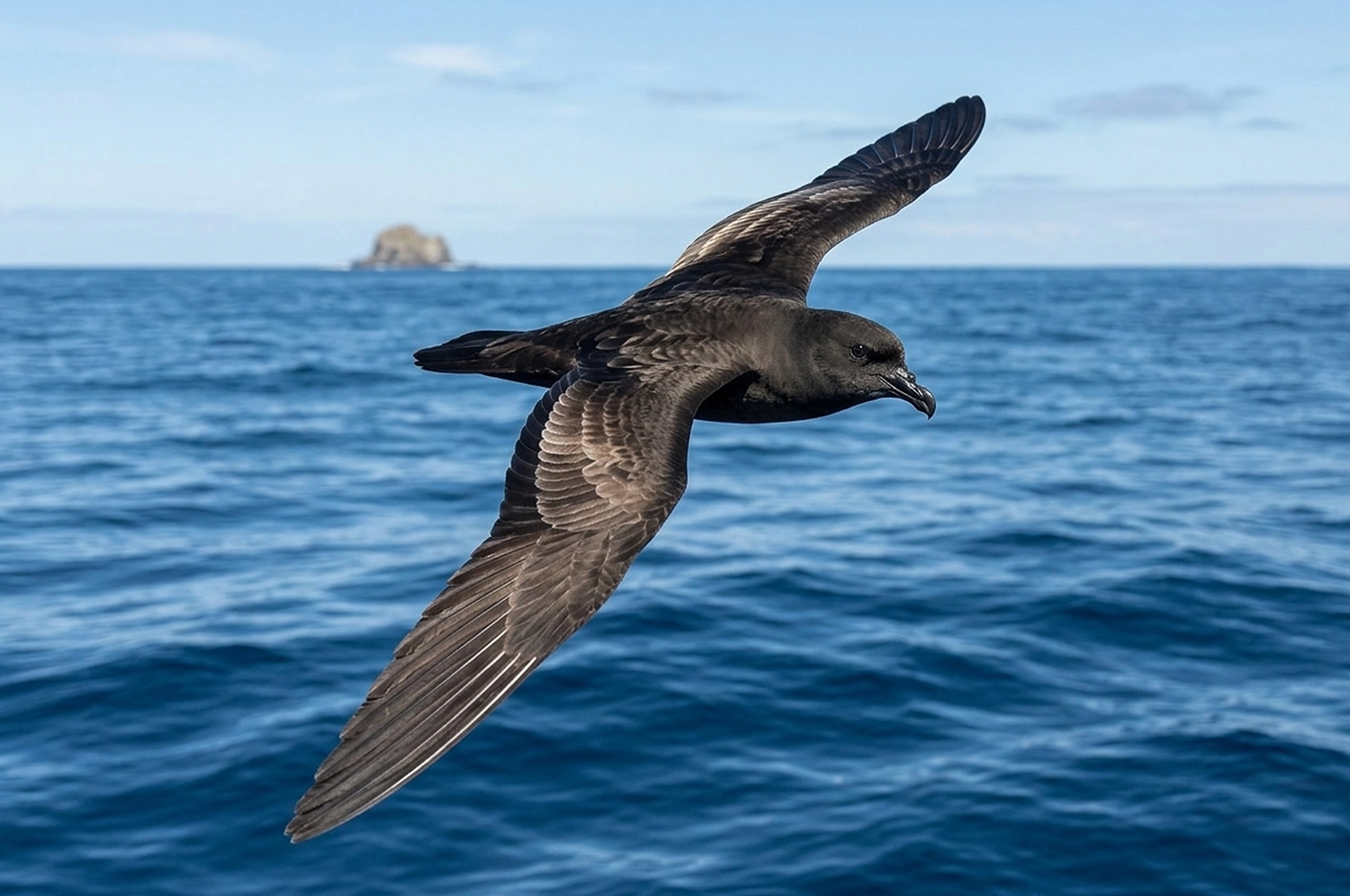
This medium-sized seabird measures approximately 25–29 cm in length with an impressive wingspan of 78–90 cm. It is characterized by its uniform dark brown plumage and a uniquely long, pointed tail. Its wings are notably long and slender, allowing for a buoyant, twisting flight pattern that is distinct among petrels.
Habitat
The Bulwer's petrel is a highly pelagic species, meaning it inhabits the open ocean and is rarely seen near land except during the breeding season. It has a vast distribution, ranging from the Macaronesian Islands in the Atlantic to the Hawaiian and Marquesas Islands in the Pacific. During the breeding season, they seek out offshore islands with varied terrain for nesting.
Diet
The diet of the Bulwer's petrel consists primarily of small fish (such as sardines) and squid. They also consume marine invertebrates, including crustaceans like crabs, krill, and shrimp, as well as sea-striders and plankton. They are known to be nocturnal feeders, seizing prey from the water's surface under the cover of darkness.
Breeding and Nesting
Breeding usually begins in April or May. These birds form colonies on remote offshore islands, utilizing a variety of nesting sites such as burrows, rock crevices, cracks, or caves. They may also nest under heavy vegetation or debris to protect their single egg from predators and the elements.
Behavior
Bulwer's petrels exhibit a buoyant and erratic flight style as they skim the ocean surface for food. They are predominantly nocturnal when it comes to feeding and visiting nesting colonies, a behavior likely evolved to avoid predation by gulls and hawks. Outside of the breeding season, they lead a solitary existence in the deep marine environment.
Conservation Status - LC Least Concern
While the Bulwer's petrel has a very large range and a stable population in many areas, it is vulnerable to localized threats. The primary concerns include habitat degradation and the introduction of invasive predators (like rats and cats) on their breeding islands. In many regions, they are protected under conservation management plans to ensure their nesting sites remain secure.
Interesting Facts
- The bird is named after James Bulwer, a 19th-century English naturalist and cleric.
- Unlike many other petrels with square or forked tails, the Bulwer's petrel has a noticeably long and pointed tail.
- It is a rare vagrant, occasionally appearing far from its usual range in places like Ireland, North Carolina, and Australia.
- They use a 'surface-seizing' technique to catch prey while hovering or swimming.
Tips for Birdwatchers
To spot a Bulwer's petrel, your best bet is to join a pelagic birdwatching boat trip, particularly in the Atlantic near the Madeira or Canary Islands during the summer months. Because they are nocturnal near land, viewing them at their nesting sites is difficult and often discouraged to prevent disturbing the colonies; instead, focus on deep-sea crossings where their twisting flight can be identified.
Conclusion
The Bulwer's petrel is a master of the open ocean, perfectly adapted to a life spent riding the sea winds. From its mysterious nocturnal habits to its incredible migratory reach, it remains a highlight for any birdwatcher or marine biologist interested in the wonders of pelagic life.
