
Introduction
The Collared Falconet (Microhierax caerulescens) is a remarkable member of the Falconidae family and stands as one of the smallest birds of prey in the world. Often mistaken for a songbird due to its size, this fierce raptor is a master of the skies across the Indian Subcontinent and Southeast Asia.
Physical Appearance
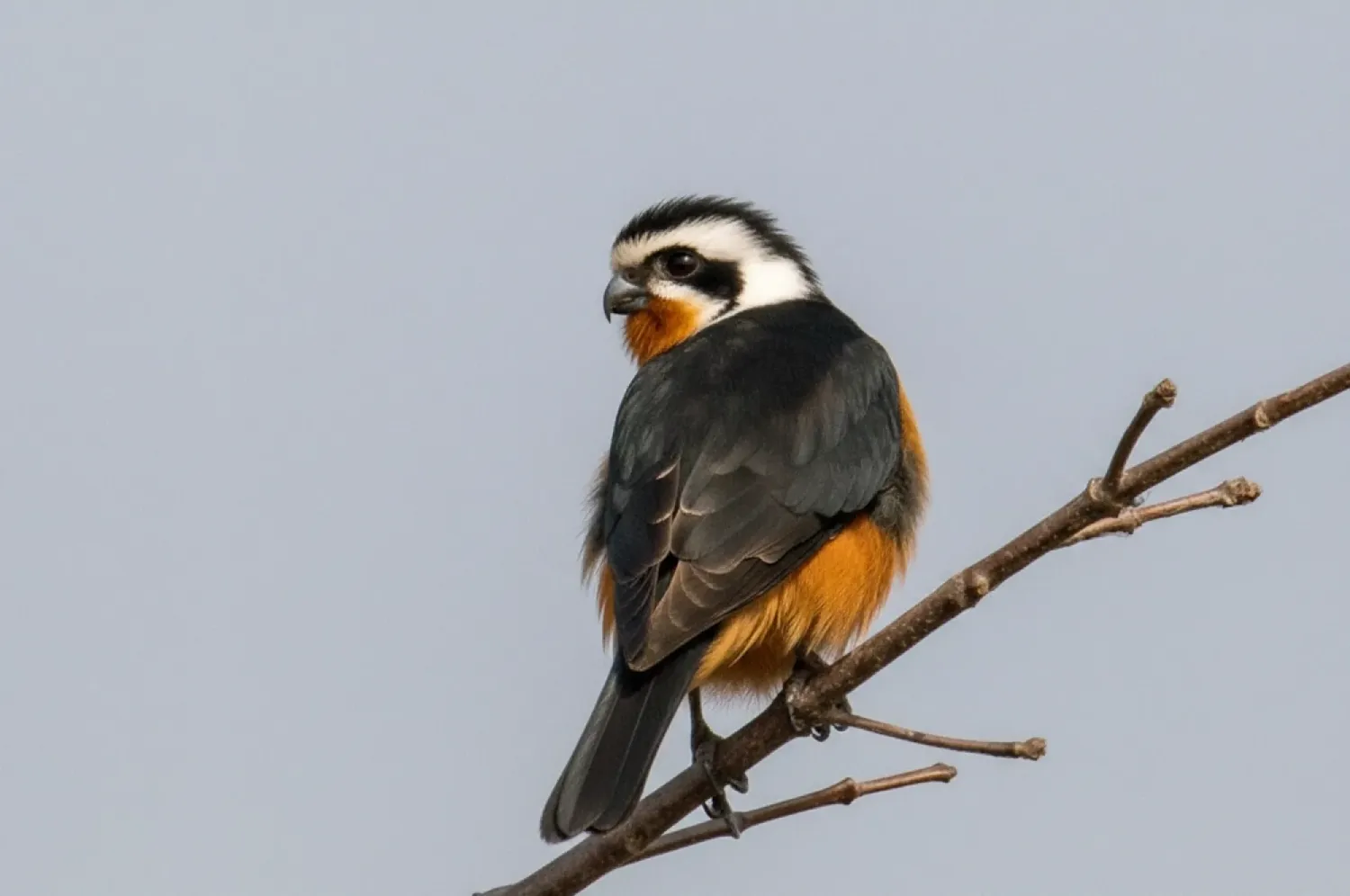
Measuring approximately 18 cm in length, the Collared Falconet is roughly the size of a sparrow. It features a striking black-and-white plumage with a prominent white collar that gives the species its name. When perched, its silhouette is notably shrike-like, showing a compact body and a sharp, hooked beak characteristic of falcons.
Habitat
This species prefers open deciduous forests, clearings, and the edges of evergreen forests. They are frequently found in abandoned hill cultivation areas that still contain some trees, often in close proximity to water sources. Their distribution typically ranges from 200 to 800 meters in elevation, though they are regularly recorded up to 1,700 meters.
Diet
The diet of the Collared Falconet consists primarily of large insects such as butterflies, dragonflies, and beetles. Despite their small size, they are also capable of hunting small birds and lizards, utilizing their speed and agility to capture prey mid-air or from the foliage.
Breeding and Nesting
Collared Falconets are secondary cavity nesters, often utilizing abandoned woodpecker or barbet holes in tall trees. These nests are typically located high above the ground to provide protection from predators. The breeding season generally aligns with the warmer months when insect populations are at their peak.
Behavior
In flight, the Collared Falconet exhibits rapid wingbeats interspersed with long, smooth glides. They are often seen perching on high, exposed branches where they scan for passing prey. Unlike many larger solitary raptors, they are somewhat social and can be spotted in small family groups or pairs.
Conservation Status - LC Least Concern
The Collared Falconet is currently classified as Least Concern by the IUCN. While they have a wide distribution across countries like India, Thailand, and Vietnam, they are still vulnerable to habitat loss caused by deforestation and the conversion of forests into agricultural land.
Interesting Facts
- It is one of the smallest raptors on the planet, barely larger than a common sparrow.
- The bird's hunting style is incredibly aggressive for its size, often taking down prey nearly as large as itself.
- Its range extends across ten different countries in Asia, including Bhutan, Laos, and Malaysia.
- The white collar and facial markings provide excellent camouflage against the dappled light of the forest canopy.
Tips for Birdwatchers
- Focus your search on dead snags or exposed branches at the edge of forest clearings.
- Look for them near water bodies, as these areas attract the large insects they feed on.
- Listen for their high-pitched calls, which can help locate them before they are seen.
- Use binoculars to distinguish them from shrikes, which share a similar perching posture.
Conclusion
The Collared Falconet is a captivating example of nature's diversity, packing the power of a falcon into a tiny, shrike-sized body. For birdwatchers exploring the forests of Southeast Asia, spotting this mini-raptor is a true highlight that demonstrates the incredible complexity of avian ecosystems.