
Introduction
The House Crow (Corvus splendens), also known as the Indian or greynecked crow, is a highly intelligent and adaptable member of the crow family. Originally from Asia, this bird has successfully expanded its range globally, often following human settlement and maritime routes.
Physical Appearance
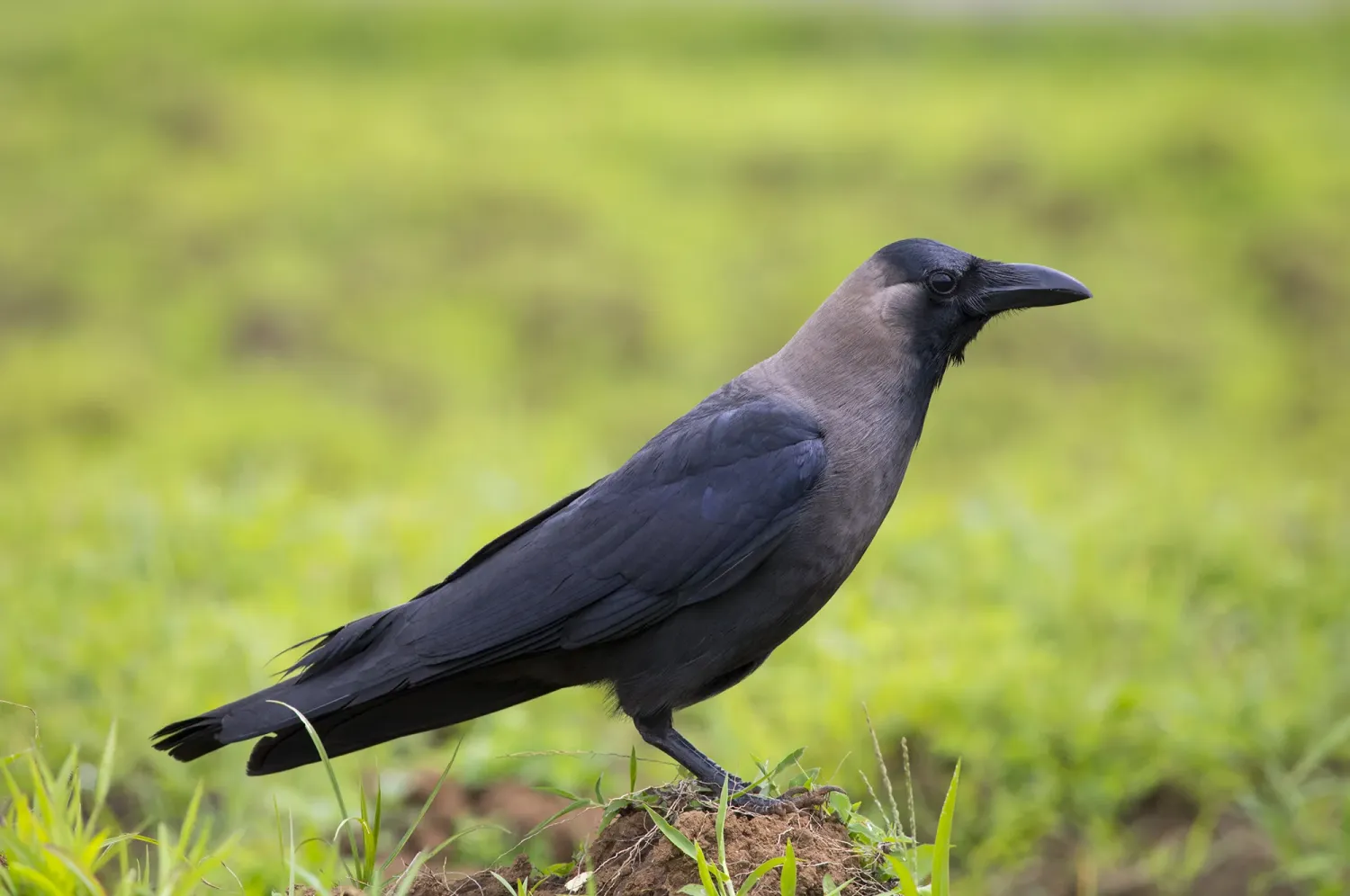
The House Crow is a medium-sized bird, measuring approximately 40 cm in length. It is slimmer than a carrion crow. Its key physical features include:
- Plumage: A richly glossed black forehead, crown, throat, and upper breast.
- Neck and Breast: A distinctive lighter grey-brown color that contrasts with the black.
- Wings and Tail: Solid black feathers.
- Legs and Bill: Entirely black, with regional variations in bill thickness.
Habitat
The House Crow is primarily found around human habitation and cultivation. It is a common sight in towns, villages, and particularly near busy harbors. While it thrives in urban settings, it still requires trees for nesting and roosting. Common habitats include:
- Mangroves and coconut groves.
- Plantations, especially those with banyan trees.
- Urban centers and agricultural fields.
Diet
As a highly opportunistic omnivore, the House Crow plays a major role as a scavenger. Its diet includes:
- Human leftovers, rubbish, and debris found in sewage.
- Small animals such as lizards, fish, frogs, and insects.
- Crabs, nectar, fruits, and cereal seeds.
- Chicks, eggs, and small mammals.
Breeding and Nesting
House Crows typically build their nests in trees, often favoring banyan or coconut palms. The nests are constructed using sticks and twigs, and in urban areas, they may even incorporate pieces of wire. They are known to be protective of their nesting sites during the breeding season.
Behavior
House Crows are extremely social and vocal birds. They are often seen in large groups, especially where food is abundant. They are known for their intelligence and problem-solving skills. Their ability to hitch rides on ships has allowed them to colonize many parts of the world outside their native Asian range.
Conservation Status - LC Least Concern
The House Crow is currently listed as Least Concern. Because they thrive in human-altered environments, their population is stable and even increasing in many areas, though they are considered an invasive species in some regions.
Interesting Facts
- It is also known as the Ceylon or Colombo crow.
- They are often assisted by shipping to reach new geographical territories.
- The House Crow is smaller than a carrion crow but larger than a jackdaw.
- They serve as important urban cleaners by consuming organic waste.
Tips for Birdwatchers
- Look for them near fishing harbors and outdoor food markets.
- Observe their clever foraging behavior in urban parks.
- Listen for their distinct, harsh cawing sounds to locate them in thick foliage.
- Use binoculars to spot the subtle grey-brown gradient on their necks.
Conclusion
The House Crow is a remarkable example of avian adaptability. Whether scavenging in a busy city or nesting in a coconut grove, this intelligent bird remains one of the most successful urban species in the world, deeply intertwined with human civilization.
