
Introduction
The Indian Courser (Cursorius coromandelicus) is a distinctive ground-dwelling bird belonging to the family Glareolidae. Found primarily across the dry plains of South Asia, this species is celebrated for its elegant appearance and remarkable speed on foot.
Physical Appearance
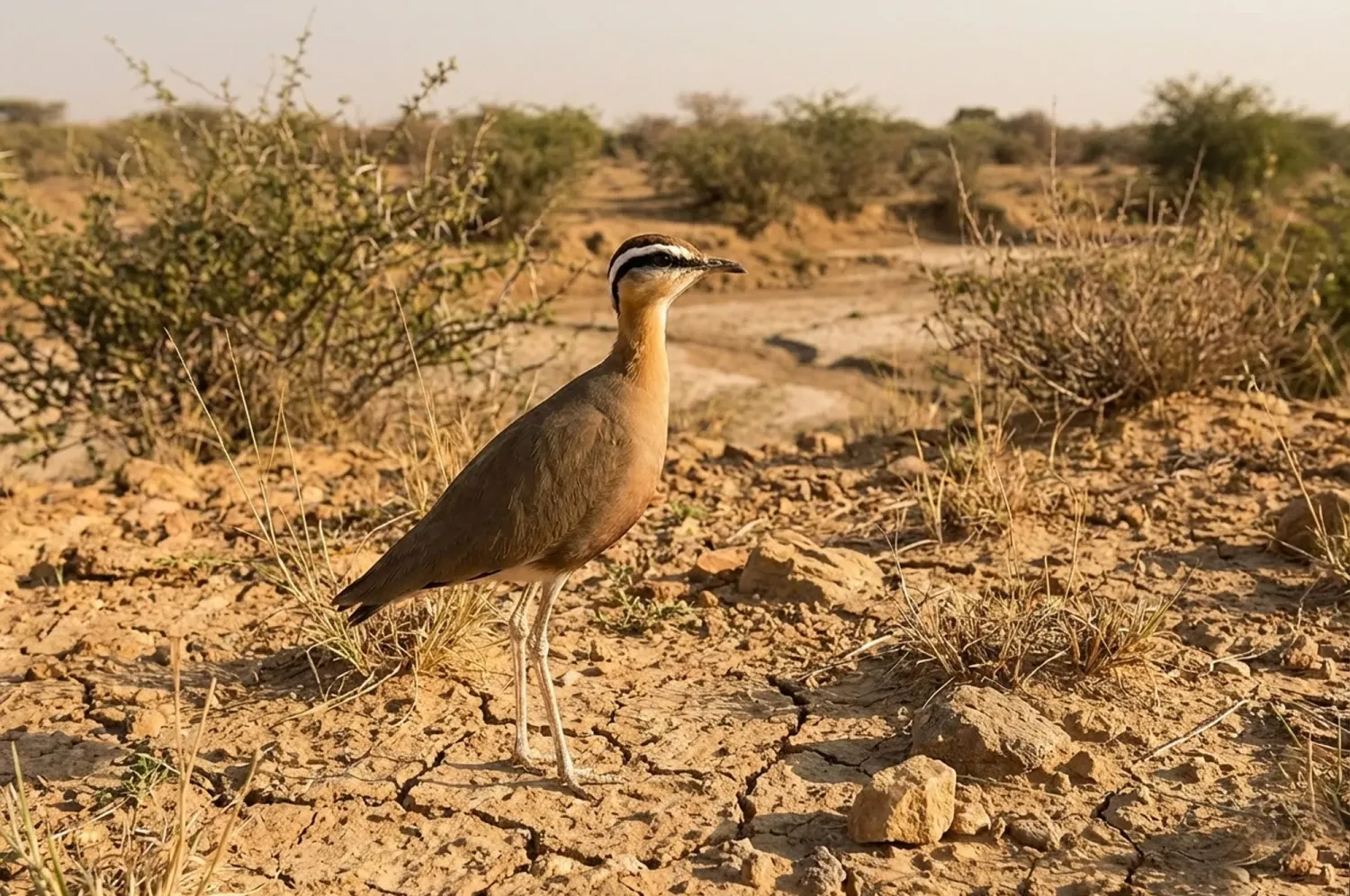
The Indian Courser is a medium-sized bird with a length of approximately 23 cm. It possesses a sandy-brown body that blends perfectly with arid environments. Its most striking features include a rufous crown, a broad white supercilium, and a sharp black stripe passing through the eye. It has long, cream-colored legs and a slightly down-curved bill, ideal for foraging on the ground.
Habitat
Unlike many of its relatives, the Indian Courser avoids wetlands. It prefers open, dry, and stony landscapes, including fallow agricultural fields, scrublands, and semi-desert regions. It is well-adapted to the arid plains of the Indian subcontinent.
Diet
This species is primarily insectivorous. Its diet consists of a variety of ground-dwelling invertebrates, such as beetles, crickets, grasshoppers, and ants. It uses a "run-and-pause" method to locate and snatch its prey from the surface of the soil.
Breeding and Nesting
The breeding season typically spans from March to August. The Indian Courser does not construct a formal nest; instead, it lays 2 to 3 cryptically colored eggs directly on the bare ground or in a shallow scrape. This camouflage is essential for protecting the eggs from predators in open terrain.
Behavior
True to its name, the Indian Courser is an exceptional runner. When disturbed, it often chooses to run swiftly across the ground rather than take flight. It exhibits a characteristic behavior of running a short distance, stopping abruptly, and then standing erect to survey its surroundings.
Conservation Status - NT Near Threatened
The Indian Courser is currently listed as Least Concern on the IUCN Red List. While the population is generally stable, they are increasingly threatened by habitat loss due to intensive agriculture and industrial development in dryland areas.
Interesting Facts
- The Indian Courser is a non-migratory bird, though it may make local movements based on food availability and rainfall.
- Despite being classified as a wader, it has entirely abandoned aquatic habitats in favor of dry land.
- Its eggs are so well-camouflaged that they are almost indistinguishable from the stones and dirt surrounding them.
- The name 'Courser' is derived from the Latin word 'currere,' which means 'to run.'
Tips for Birdwatchers
- The best time to spot them is during the early morning or late afternoon when they are most active.
- Scan open, fallow fields or stony wastelands with binoculars, as their plumage provides excellent camouflage.
- Move slowly and maintain a distance; these birds are shy and will quickly run away if they feel threatened.
Conclusion
The Indian Courser is a fascinating specialist of the dry plains. Its unique adaptations to life on the ground and its striking facial patterns make it a highlight for any birdwatcher exploring the diverse landscapes of South Asia.