
Introduction
The Indian Robin (Saxicoloides fulicatus) is a small, charismatic passerine bird belonging to the family Muscicapidae. Widespread across the Indian subcontinent, this bird is a common sight in rural and semi-urban landscapes. Known for its lively nature and distinctive upright tail, it is a favorite among bird enthusiasts in countries like India, Pakistan, Sri Lanka, and Nepal.
Physical Appearance
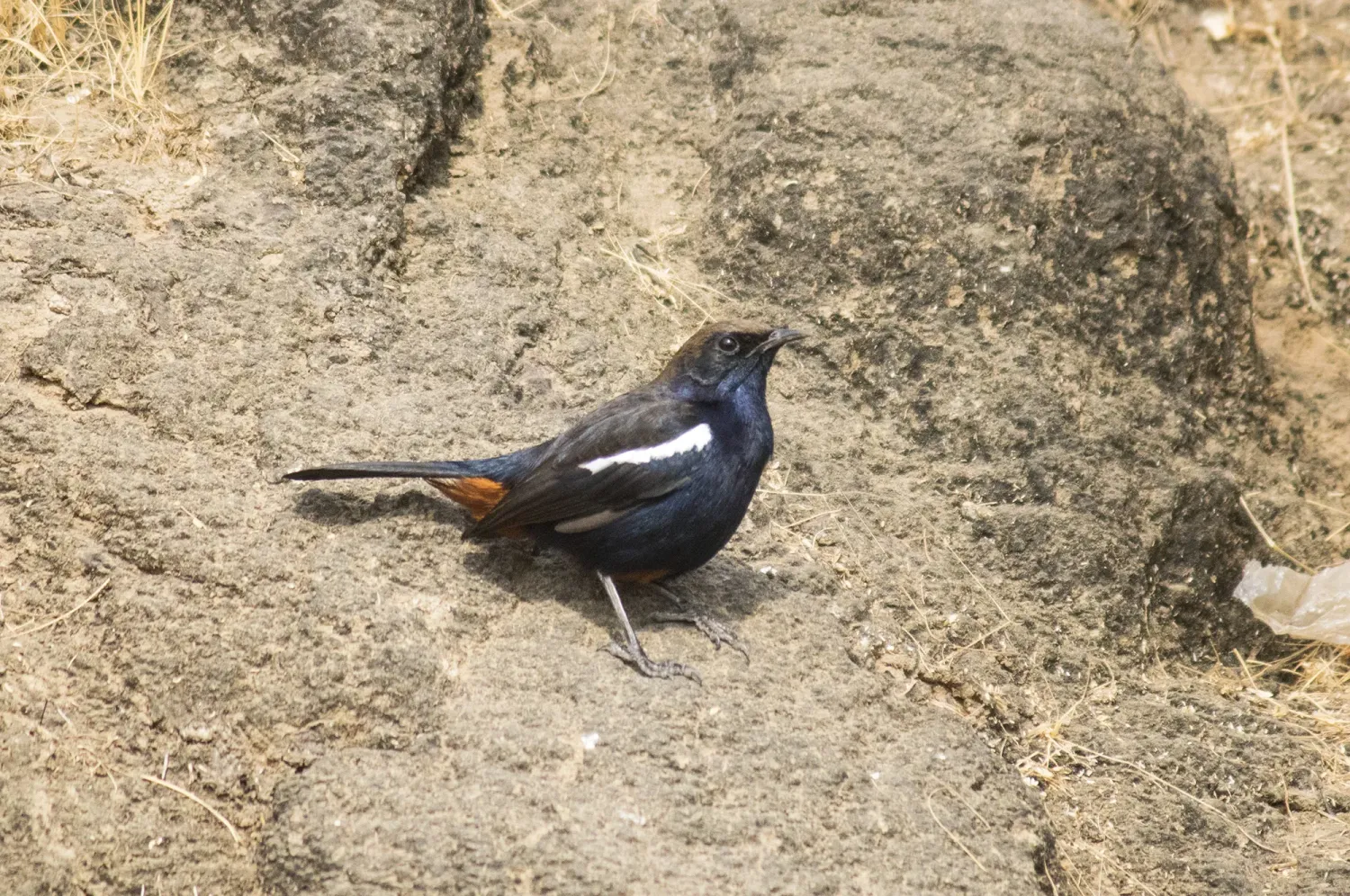
Measuring approximately 19 cm in length, the Indian Robin is easily identifiable. The males are mostly black with a white shoulder patch and prominent chestnut undertail coverts. Interestingly, northern populations of males have brown backs, which transition to all-black in the southern peninsula. Females and juveniles are generally brownish-grey and lack the striking black plumage of the males but still feature the characteristic chestnut vent. Their long tails are frequently held in a cocked-up position.
Habitat
The Indian Robin thrives in dry stony areas, open scrublands, and the edges of cultivation. They are well-adapted to arid environments and are often spotted in rocky terrains or perched on low thorny shrubs. Unlike many other species, they avoid dense forests, preferring open spaces where they can easily forage on the ground.
Diet
These birds are primarily insectivorous, feeding on a wide variety of insects. However, they are opportunistic hunters and have been known to capture frogs and lizards, particularly when they have young to feed at the nest. A unique behavioral trait is their tendency to forage late into the evening, often capturing insects that are attracted to artificial lights.
Breeding and Nesting
Breeding typically occurs between March and June. The Indian Robin builds its nest in protected cavities, such as holes in walls, hollow trees, or even on the ground tucked under a rock or thick vegetation. The nest is usually lined with grass, hair, and sometimes even pieces of snake slough. Both parents are actively involved in protecting the territory and feeding the chicks.
Behavior
The Indian Robin is a ground-dwelling bird often seen running along the ground in search of prey. It has a habit of perching on low rocks or shrubs while constantly flicking its tail upward. They are solitary or found in pairs and are known for their melodious whistling songs, which are most frequent during the breeding season.
Conservation Status - LC Least Concern
The Indian Robin is currently classified as Least Concern by the IUCN. Due to its wide distribution and ability to adapt to human-modified landscapes, its population remains stable across its range.
Interesting Facts
- The species shows a distinct clinal variation, where the back color of males changes from brown in the north to black in the south.
- They are often confused with the Oriental Magpie Robin, but can be distinguished by their chestnut undertail coverts.
- Indian Robins are known to use snake skins to line their nests, possibly as a deterrent to predators.
- They are bold birds and are often found living in close proximity to human settlements.
Tips for Birdwatchers
- Look for them in open scrub areas or near rocky outcrops early in the morning.
- Scan low-lying branches and rocks, as they rarely perch high in trees.
- Listen for a short, cheery whistling song to locate them in the brush.
- Observe their tail movements; a cocked-up tail is a definitive sign of an Indian Robin.
Conclusion
The Indian Robin is a delightful and resilient species that adds life to the dry landscapes of South Asia. With its unique appearance and bold personality, it remains one of the most recognizable birds for both novice and experienced birdwatchers. Protecting their scrubland habitats ensures that these feathered companions continue to thrive alongside human civilizations.
