
Introduction
The Bearded Vulture, scientifically known as Gypaetus barbatus, stands as one of the most magnificent and enigmatic birds of prey in the world. Often referred to as the 'Lammergeier' or 'Ossifrage,' this raptor belongs to the Accipitridae family and occupies a unique ecological niche. Unlike most vultures that focus primarily on soft tissue, the Bearded Vulture has evolved a specialized diet that sets it apart from its scavenging counterparts. Historically misunderstood and persecuted, this bird is now recognized as a vital component of mountain ecosystems across Europe, Asia, and Africa. Its striking appearance, characterized by a dramatic contrast between its grey and orange plumage, makes it a highly sought-after subject for birdwatchers and conservationists alike. As an apex scavenger, it plays an essential role in keeping mountain environments clean by disposing of animal carcasses, including large bones that other scavengers cannot consume. Understanding the biology and behavior of this iconic species is crucial for ongoing conservation efforts aimed at protecting its fragile populations in the wild.
Physical Appearance
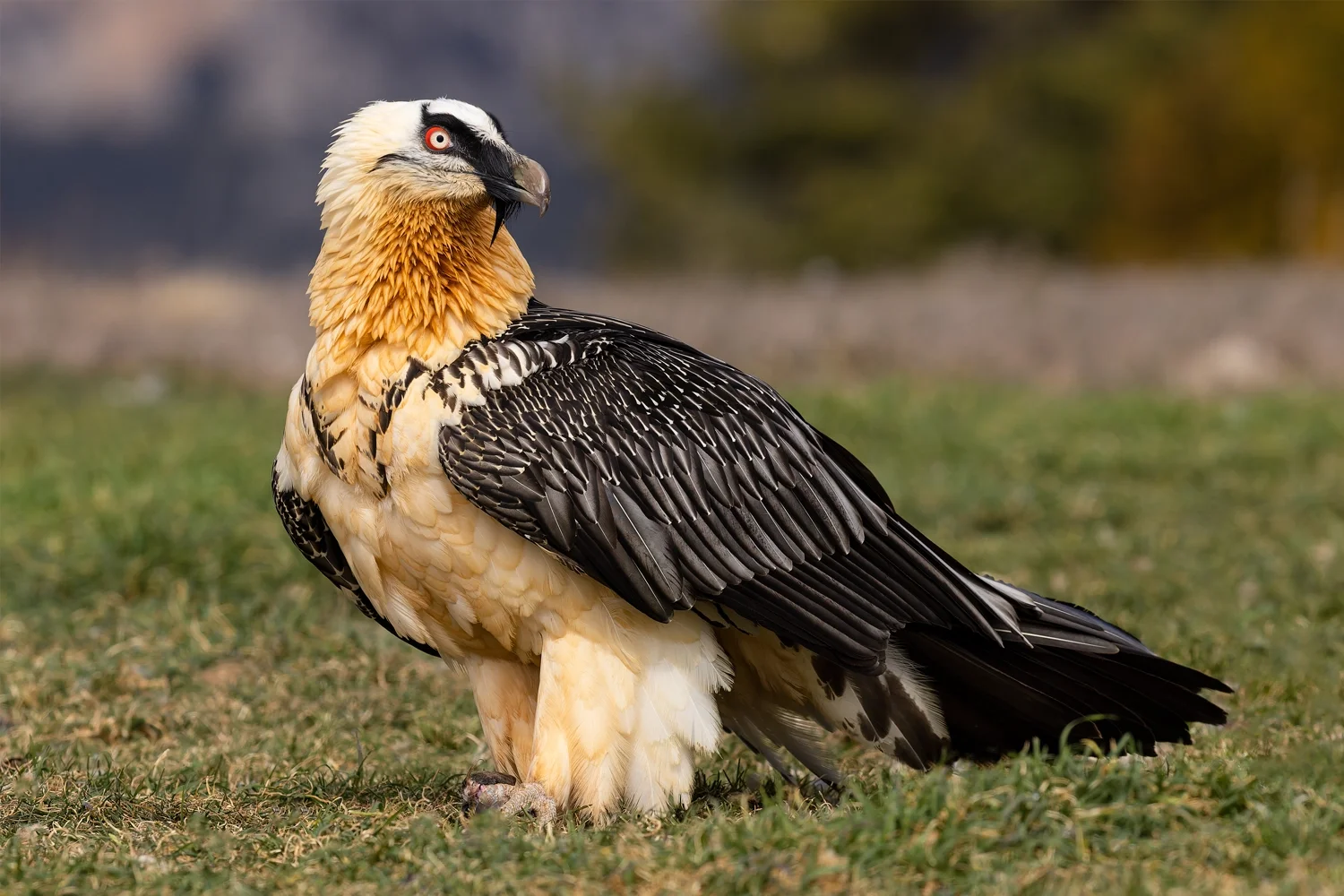
The Bearded Vulture is a large, powerful raptor measuring between 94 and 125 centimeters in length, with a wingspan that can exceed 2.5 meters. Its physical appearance is striking, featuring a blend of sophisticated colors that provide excellent camouflage in rocky mountain environments. The primary color of the bird is a slate-grey or charcoal, covering its wings and tail, while the secondary color consists of a rich, warm orange or rusty-brown hue. Interestingly, this orange coloration is not innate; the birds intentionally stain their feathers by bathing in iron-rich water or mud, a behavior known as cosmetic staining. The head is partially covered with dark bristles that form a distinctive 'beard' under the chin, which gives the species its common name. The eyes are piercing with a red iris surrounded by a dark sclera, adding to its intense gaze. Its body is streamlined, designed for soaring effortlessly on thermal currents over rugged terrain. The combination of its powerful talons, sharp hooked beak, and aerodynamic silhouette makes it perfectly adapted for its life in high-altitude mountain ranges.
Habitat
The Bearded Vulture primarily inhabits high-altitude mountainous regions. Its range spans across the Pyrenees, the Alps, and the mountains of Central Asia, as well as parts of Eastern and Southern Africa. These birds prefer remote, rugged landscapes with steep cliffs, deep gorges, and expansive mountain pastures. Such terrain provides the necessary thermal updrafts required for their energy-efficient soaring flight, allowing them to survey vast territories with minimal effort. They are typically found at elevations ranging from 1,000 to 4,500 meters above sea level. This vertical distribution allows them to exploit various ecological zones, provided there is sufficient prey availability and nesting sites available on inaccessible rock ledges. Due to their specific environmental requirements, they are highly sensitive to habitat fragmentation and human disturbance, making the preservation of high-altitude wilderness areas critical for their continued survival in these diverse geographic regions.
Diet
The diet of the Bearded Vulture is unique among all living birds, as it is the only vertebrate that subsists primarily on bone marrow. While they will consume carrion, they have evolved to specialize in swallowing large bone fragments from carcasses left behind by other predators. Their digestive system is incredibly acidic, capable of dissolving bone in a matter of hours. To access the marrow inside large bones that are too big to swallow whole, the Bearded Vulture exhibits a highly specialized behavior: it carries the bone to a great height and drops it onto flat rocks below, shattering it into bite-sized pieces. This 'bone-cracking' strategy allows them to consume the nutrient-rich marrow, a food source that is largely ignored by other scavengers. This niche specialization reduces competition with other vultures, allowing the species to thrive in environments where food might otherwise be scarce.
Breeding and Nesting
Breeding for the Bearded Vulture is a slow and deliberate process that typically occurs during the winter months. These birds are known for their strong pair bonds and often exhibit elaborate courtship displays, including synchronized flying and aerial maneuvers. They construct large, bulky nests made of sticks, wool, and animal remains, usually situated on inaccessible cliff ledges or in shallow caves to protect their offspring from predators. A typical clutch consists of one to two eggs, with an incubation period lasting around 50 to 60 days. Interestingly, even if two chicks hatch, the older and stronger one often dominates, a phenomenon known as facultative siblicide. Both parents are highly involved in the rearing process, providing food and protection for several months. The fledging period is extensive, with young birds remaining dependent on their parents for up to a year, ensuring they are well-prepared for the harsh conditions of their mountain habitat before venturing out on their own.
Behavior
The behavior of the Bearded Vulture is characterized by its solitary nature and mastery of flight. They are incredibly efficient gliders, capable of navigating complex mountain winds to travel long distances in search of food. Unlike many other vulture species that congregate in large groups, Bearded Vultures are often seen alone or in pairs. They are highly territorial, defending their expansive home ranges from other raptors and intruders. Their intelligence is evident in their bone-dropping technique and their ability to recognize specific geographic features. They are also known to be wary of humans, typically avoiding areas with high human activity. Their social structure is relatively simple, focusing on pair stability and territorial maintenance, which is essential for successfully raising offspring in the unforgiving, high-altitude environment they call home.
Conservation Status - NT Near Threatened
The Bearded Vulture is currently listed as 'Near Threatened' on the IUCN Red List. Historically, the species suffered significant population declines due to direct persecution by humans, who wrongly perceived them as threats to livestock and children. Additionally, poisoning from lead-based ammunition and habitat loss have posed severe threats to their recovery. Conservation efforts, including captive breeding and reintroduction programs in the Alps, have seen some success in stabilizing local populations. Protecting these birds requires ongoing efforts to reduce lead contamination in the environment, secure safe nesting sites, and minimize human disturbance in their mountainous territories. Continued monitoring and international cooperation are vital to ensuring the long-term viability of this majestic species.
Interesting Facts
- They are the only birds that consume a diet consisting of 70-90% bone marrow.
- The orange color on their plumage is actually a result of bathing in iron-rich mud.
- They can digest bones that would be impossible for almost any other animal to process.
- Their wingspan can reach up to 2.8 meters in width.
- They drop bones from heights of up to 80 meters to crack them open.
- Despite their size, they are extremely agile in the air and can perform complex aerial maneuvers.
- They have been known to live for over 40 years in captivity.
Tips for Birdwatchers
For birdwatchers hoping to spot a Bearded Vulture, patience and preparation are key. Focus your search in high-altitude mountain ranges like the Pyrenees or the Alps, particularly during the early morning when thermals begin to rise. Use high-quality binoculars or a spotting scope, as these birds often soar at great heights, making them difficult to identify with the naked eye. Look for their distinct silhouette, which includes long, narrow wings and a wedge-shaped tail. It is also helpful to monitor areas near known cliff nesting sites or carcasses, though maintain a respectful distance to avoid disturbing them. Checking local birding reports and joining guided mountain tours can significantly increase your chances of witnessing this magnificent raptor in its natural environment. Always prioritize the bird's welfare by staying on marked trails and keeping noise levels to a minimum.
Conclusion
In conclusion, the Bearded Vulture (Gypaetus barbatus) is a testament to the wonders of evolutionary adaptation. From its unique bone-crushing diet to its striking orange and grey plumage, this bird of prey occupies a singular place in the natural world. Its role as a mountain scavenger is vital for the health of its ecosystem, yet its survival remains precariously linked to our conservation actions. By understanding the challenges these birds face—ranging from habitat loss to the dangers of lead poisoning—we can better support the initiatives aimed at their protection. Birdwatchers and nature enthusiasts play a key role in this by fostering awareness and advocating for the preservation of high-altitude wilderness. Protecting the Bearded Vulture is not just about saving a single species; it is about maintaining the integrity of our mountain landscapes for future generations. As we continue to study and admire these birds, let us remain committed to ensuring that the skies above our mountain ranges remain graced by their powerful and graceful presence for many years to come.