
Introduction
The Brahminy Kite (Haliastur indus) is a distinctive medium-sized bird of prey belonging to the family Accipitridae. Known for its striking color contrast and its common presence near water bodies, this raptor is a familiar sight across South Asia, Southeast Asia, and as far south as Australia. It is often admired for its graceful flight and scavenging efficiency.
Physical Appearance
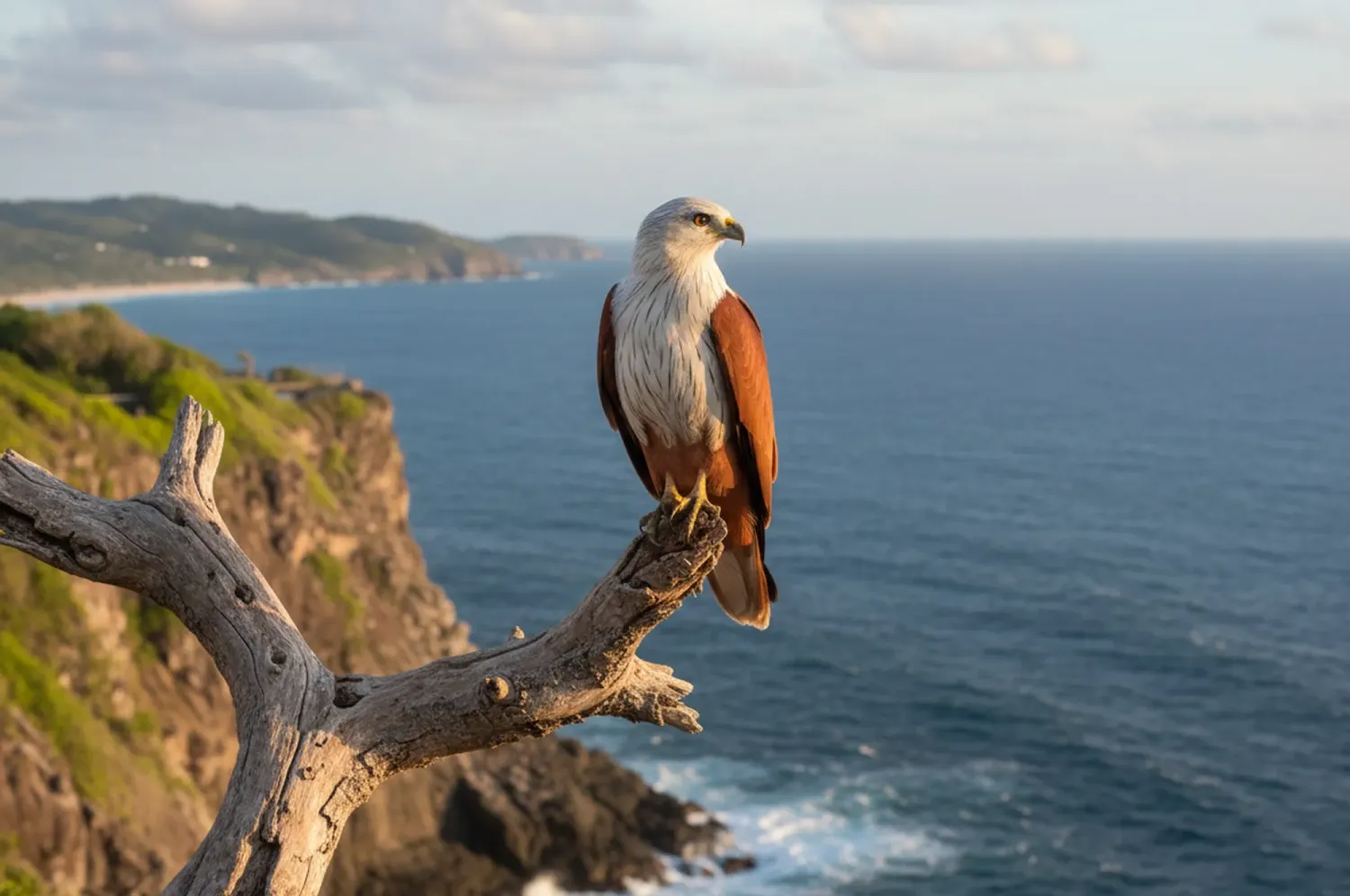
The Brahminy Kite is an attractive bird, measuring approximately 48 cm in length. It features a rich chestnut plumage across its body, which contrasts sharply with its white head and breast. The wing tips are black, and unlike other kite species like the Red or Black Kite which have forked tails, the Brahminy Kite possesses a rounded tail. Its flight is typical of kites, with wings held at an angle.
Habitat
This species is highly dependent on the vicinity of water, whether fresh or salt. Its habitat includes:
- Marshes and flooded paddy-fields
- Tanks, reservoirs, and rivers
- Estuaries, coastal lagoons, and mangroves
- Harbours and fishing villages
It is frequently observed perching on tall trees overlooking the water, scanning the surface for potential prey.
Diet
The Brahminy Kite is an opportunistic feeder with a diverse diet. It feeds on a wide variety of small prey and carrion. Its diet includes:
- Mammals, birds, and reptiles
- Aquatic animals such as fish, crustaceans, and amphibians
- Flying insects, which it often hawks in mid-air
- Food obtained through piracy from other fishing birds
They are also known to gather around large carcasses, where they often emit squealing sounds while feeding.
Breeding and Nesting
Brahminy Kites typically build their nests in tall trees, often choosing species that are close to water sources. The nests are constructed using sticks and lined with leaves or other soft materials. Breeding seasons vary by geography, but they are generally resident birds that remain in their territory year-round.
Behavior
These birds are known for their soaring flight and scavenging nature. They are resident birds throughout their range, from Pakistan and India to New South Wales, Australia. They are often seen alone or in pairs, though large numbers may congregate at rich food sources like fishing docks or large carcasses. Their behavior includes kleptoparasitism, where they steal food from other predators.
Conservation Status - LC Least Concern
The Brahminy Kite is currently listed as Least Concern on the IUCN Red List. While they remain widespread and common in many parts of their range, local populations can be affected by habitat loss, pollution of water bodies, and changes in traditional fishing practices.
Interesting Facts
- Unlike many other kite species, the Brahminy Kite has a distinctly rounded tail rather than a forked one.
- In Indonesia, it is known as 'Elang Bondol' and serves as the official mascot of Jakarta.
- It is a highly adaptable scavenger, often seen in busy human environments like harbors and fish markets.
- The bird's range is massive, extending from the Indian subcontinent through Southeast Asia to Australia.
- In some cultures, particularly in India, it is considered a sacred bird associated with the deity Vishnu.
Tips for Birdwatchers
To spot a Brahminy Kite, look near coastal areas, estuaries, or large inland wetlands. They are most active during the day and can often be seen perched on high branches or poles near water. Using a pair of binoculars, look for the signature white head and chestnut body to distinguish it from the more common Black Kite.
Conclusion
The Brahminy Kite is a remarkable and beautiful raptor that plays a vital role in its ecosystem as both a predator and a scavenger. Its striking appearance and proximity to human settlements make it one of the most recognizable and beloved birds of prey in the Indo-Pacific region.
