
Introduction
The Lazuline Sabrewing (Campylopterus falcatus) is a breathtakingly beautiful member of the Trochilidae family, often considered one of the most striking hummingbirds found within the northern Andean regions. Known for its intense, iridescent plumage, this perching bird is a jewel of the neotropical forests. Ornithologists and bird enthusiasts alike are drawn to its unique structural coloration and its assertive presence in the canopy. As a member of the sabrewing genus, it is characterized by its robust build and distinctively shaped primary feathers, which aid in its powerful flight. This species plays a critical role in the ecosystems it inhabits, acting as a vital pollinator for a wide array of native flora. By exploring the life of the Lazuline Sabrewing, one gains a deeper appreciation for the complex biodiversity of South American cloud forests and the evolutionary adaptations that allow such small creatures to thrive in challenging, high-altitude environments.
Physical Appearance
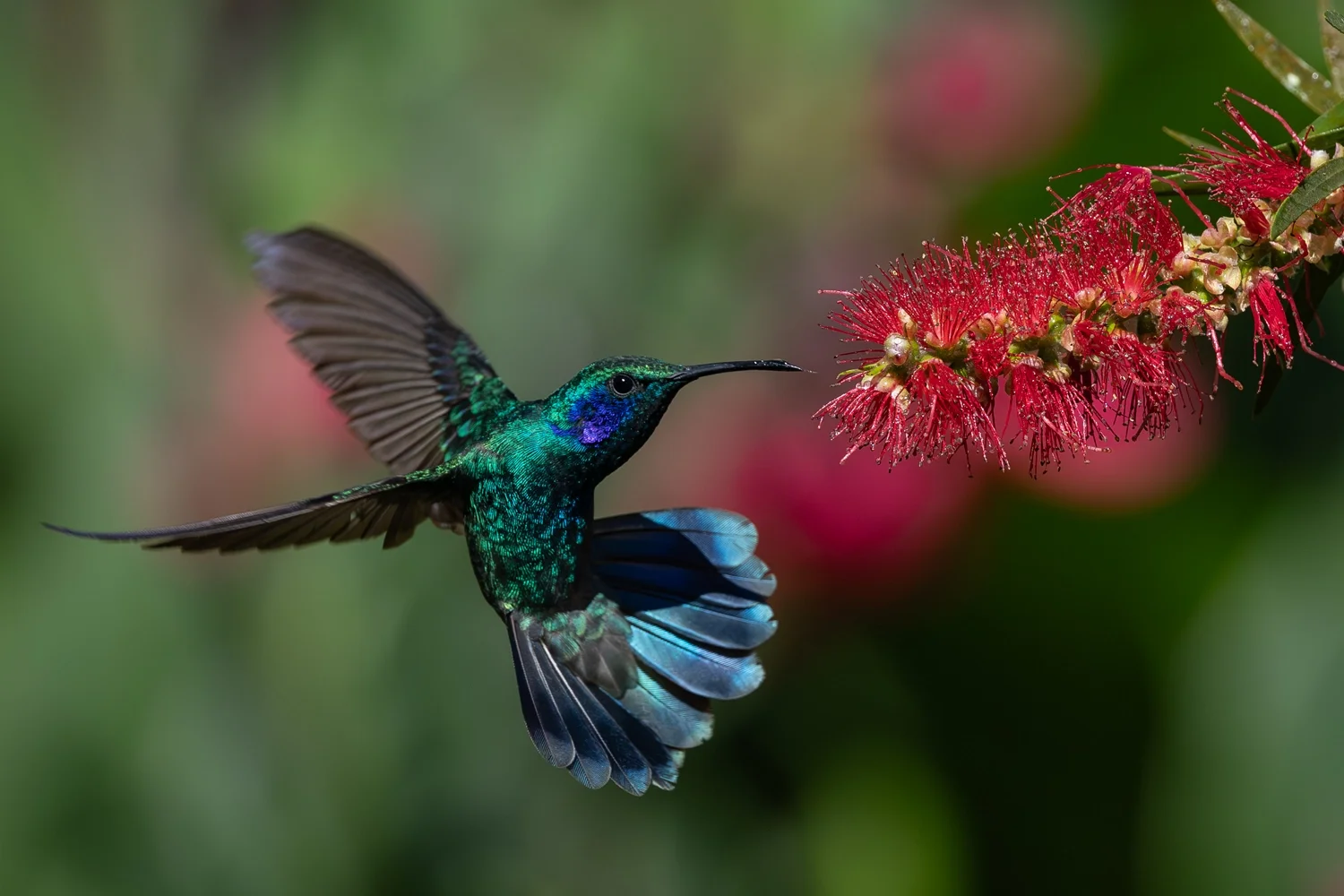
Measuring approximately 11 to 12 centimeters in length, the Lazuline Sabrewing is a medium-sized hummingbird that displays remarkable sexual dimorphism. The primary color is a deep, shimmering blue, which covers much of the bird's head, throat, and breast, reflecting light with a metallic intensity that is truly mesmerizing. This brilliant blue is complemented by a rich, emerald-green secondary color that dominates the back, wings, and flanks, creating a striking contrast. The tail is often a dark, bronzy-green or blue-black, which fans out during flight or courtship displays. A key physical feature is its bill, which is slightly decurved and perfectly adapted for reaching deep into tubular flowers. The wings are relatively broad, supporting a swift and agile flight pattern. When the bird is perched, its compact, robust body shape is evident, distinguishing it from the more delicate or slender hummingbird species found in the same range. Its overall appearance is a masterclass in avian evolution, perfectly blending form and function to navigate the dense forest understory.
Habitat
The Lazuline Sabrewing is primarily found in the foothills and mountain slopes of the northern Andes, spanning across regions in Venezuela, Colombia, and occasionally northern Ecuador. Its preferred habitat consists of humid, evergreen forests, cloud forests, and the edges of montane woodlands. Unlike some hummingbirds that prefer open fields, the Lazuline Sabrewing favors the dense, shaded environments where it can forage in the mid-story and canopy. It is frequently encountered at elevations ranging from 500 to 2,000 meters above sea level. These birds are highly dependent on the availability of flowering shrubs and trees, making them particularly sensitive to habitat fragmentation and deforestation, which can disrupt their specific micro-climates and food sources.
Diet
Like most hummingbirds, the Lazuline Sabrewing relies heavily on nectar as its primary energy source. It demonstrates a strong preference for tubular flowers, often visiting plants from the families Gesneriaceae and Ericaceae. Its decurved bill is an evolutionary adaptation that allows it to access nectar from flowers that other, shorter-billed birds cannot reach. In addition to nectar, the Lazuline Sabrewing supplements its diet with small insects and spiders, which provide essential proteins and minerals. This insectivorous behavior is particularly important during the breeding season when the demand for high-protein food sources for developing nestlings is significantly increased. They are known to be territorial around their favorite flowering patches, often defending them aggressively from other hummingbirds.
Breeding and Nesting
Breeding for the Lazuline Sabrewing is a complex process characterized by elaborate courtship displays. Males often perform aerial maneuvers and sing in communal leks or solitary perches to attract females. Once a pair is formed, the female is solely responsible for constructing the nest. The nest is a delicate, cup-shaped structure meticulously woven from soft plant fibers, moss, and spider silk to ensure both flexibility and durability. It is usually placed on a horizontal branch or within a fork of a shrub, well-hidden from predators. The female typically lays two small white eggs and incubates them for approximately two to three weeks. After hatching, the mother feeds the chicks a diet rich in insects and nectar until they are ready to fledge, which usually occurs about three weeks after hatching.
Behavior
Behaviorally, the Lazuline Sabrewing is known for being remarkably bold and somewhat pugnacious. They are not shy birds; they are frequently seen engaging in aerial chases with other hummingbirds to protect their nectar sources. Despite their aggressive territorial nature, they are also highly inquisitive. They possess a rapid, buzzing flight pattern, which is characteristic of the Sabrewing group. During the day, they alternate between periods of intense foraging and long, quiet intervals of perching on exposed branches. Their vocalizations are sharp and high-pitched, often serving as a means of communication and territorial signaling within the dense foliage of the Andean forests.
Conservation Status - LC Least Concern
Currently, the Lazuline Sabrewing is classified as a species of Least Concern by the IUCN, as it maintains a relatively stable population across its wide distribution range. However, this does not mean it is immune to threats. The primary concern for this species is the ongoing loss of habitat due to agricultural expansion and logging in the Andean region. Protecting mature cloud forests is essential for their continued survival. As climate change shifts the elevation of suitable habitats, these birds may face increased pressure, necessitating ongoing monitoring and local conservation initiatives to ensure their environment remains intact.
Interesting Facts
- The name 'Sabrewing' refers to the thickened, curved shafts of the primary wing feathers.
- They are vital pollinators for several plant species that rely exclusively on hummingbirds for reproduction.
- Lazuline Sabrewings often exhibit high territoriality, defending specific flower patches against larger birds.
- The bird's iridescent blue color is not caused by pigment, but by light refraction on its feathers.
- They are capable of hovering in mid-air with incredible precision, beating their wings dozens of times per second.
- Despite their small size, they have a surprisingly loud and repetitive song used during the breeding season.
Tips for Birdwatchers
To spot the Lazuline Sabrewing, patience is your best asset. Focus your efforts on the mid-story of cloud forests in northern Colombia or Venezuela during the early morning hours when activity is peak. Look for flowering shrubs with deep, tubular flowers, as these are primary feeding stations. Using high-quality binoculars with a close-focus capability will significantly enhance your viewing experience, allowing you to observe the bird's metallic blue plumage in detail. Listen for their sharp, distinct vocalizations, which often precede their appearance. Since they are territorial, if you find a productive flower patch, remain still and quiet; the bird will likely return to defend its territory, providing you with an excellent opportunity for observation or photography.
Conclusion
The Lazuline Sabrewing is a magnificent example of the avian diversity found within the high-altitude forests of South America. Its vibrant blue and green plumage, combined with its specialized feeding habits and pugnacious personality, make it a fascinating subject for ornithologists and a prized sighting for birdwatchers. By understanding its unique biology—from its decurved bill to its complex nesting behavior—we gain a clearer picture of the intricate ecological web it inhabits. While its current conservation status is stable, the preservation of its habitat remains a necessity to ensure that future generations can continue to witness this jewel of the Andes. Whether through supporting local conservation efforts or simply observing these birds in their natural environment with respect and care, we contribute to the broader goal of protecting our planet's fragile ecosystems. The Lazuline Sabrewing is not just a bird; it is a symbol of the beauty and resilience of the natural world, serving as a reminder of the importance of maintaining the integrity of our global forests for all species to thrive.
