
Introduction
The Barred Owl (Strix varia) is one of North America's most iconic and vocal nocturnal raptors. Known for its distinct "Who-cooks-for-you, who-cooks-for-you-all" call, this medium-sized owl has captured the imagination of birdwatchers and naturalists for generations. Unlike many other owl species that prefer open landscapes, the Barred Owl is deeply tied to the dense, mature forests of the eastern United States and parts of Canada. As a member of the Strigidae family, it exhibits the classic characteristics of a nocturnal predator: silent flight, keen hearing, and exceptional night vision.
These birds are highly adaptable, having expanded their range significantly over the past century. While they are primarily forest-dwellers, they can occasionally be found in suburban areas with large, old-growth trees. Understanding the Barred Owl requires a look into its complex social structure and its role as an apex predator in its ecosystem. They are not just silent killers; they are social creatures that engage in intricate duets and territorial displays. This comprehensive guide explores every facet of the Barred Owl, from its striking plumage to its fascinating life cycle, providing a complete overview for enthusiasts and researchers alike.
Physical Appearance
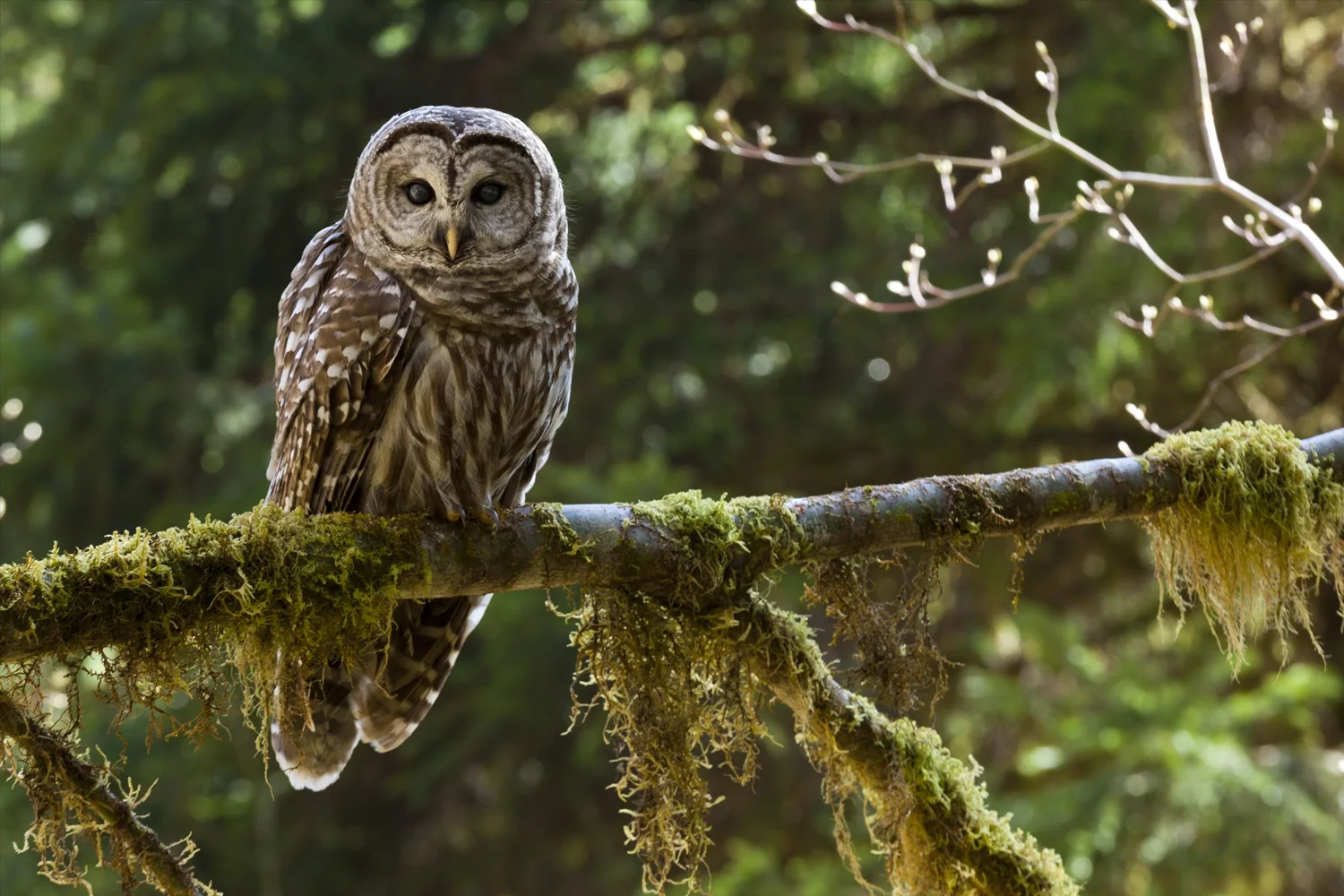
The Barred Owl is a robust, medium-sized bird, typically measuring between 48 and 50 centimeters in length. Its plumage is a masterpiece of natural camouflage, designed specifically for life among the tree shadows. The primary color is a deep, rich brown, which is intricately patterned with white horizontal bars on the chest and vertical streaks on the belly—a feature that gives the species its common name. This "barred" pattern provides excellent concealment against the bark of the trees they frequent.
Unlike many other owl species, the Barred Owl lacks ear tufts, giving its head a rounded, smooth appearance. Its most striking feature is its large, dark brown eyes. While many other owls possess yellow or orange irises, the Barred Owl's dark eyes contribute to its intense, soulful expression. The facial disk is pale with a darker brown outline, framing the eyes and beak perfectly. Their wings are broad and rounded, allowing for silent, agile flight through dense forest undergrowth. When perched, they appear stocky and powerful, with feathered legs and sharp, curved talons that are perfectly adapted for grasping prey in the dark.
Habitat
Barred Owls are quintessential inhabitants of mature, dense forests. They demonstrate a strong preference for mixed coniferous and deciduous woodlands, particularly those located near water sources such as swamps, river bottoms, or lakes. This proximity to water is crucial, as it supports a diverse population of prey animals. They rely heavily on large, old-growth trees that provide natural cavities for nesting. Because they are not strong excavators, they depend on hollows created by decay, broken branches, or abandoned nests of other large birds like hawks or crows. Their habitat range has expanded westward, demonstrating their resilience and ability to thrive in changing environments.
Diet
As an opportunistic nocturnal predator, the Barred Owl boasts an incredibly varied diet. While small mammals like mice, voles, and shrews form the bulk of their intake, they are also highly skilled at hunting amphibians, reptiles, and small birds. In areas near water, they are known to supplement their diet with crayfish, frogs, and even small fish. Their hunting strategy involves sitting perfectly still on a low branch, listening intently for the slightest rustle of prey on the forest floor. Once a target is identified, they drop silently from their perch, using their powerful talons to secure the meal with remarkable precision.
Breeding and Nesting
The breeding season for the Barred Owl typically begins in late winter or early spring. During this time, the forest comes alive with their complex territorial calls and courtship displays. Pairs are generally monogamous and may remain together for several years. They do not build their own nests; instead, they seek out deep tree cavities, often high above the ground. In the absence of suitable hollows, they will readily occupy abandoned nests of squirrels, hawks, or crows. The female typically lays a clutch of two to three white eggs, which she incubates for approximately 28 to 33 days. During this period, the male is responsible for providing food for the female. After hatching, the owlets remain in the nest for about six weeks before fledging, though they remain dependent on their parents for several more months as they learn to hunt and navigate their forest home.
Behavior
Barred Owls are primarily nocturnal, though they are occasionally active during the day, especially in dense, dark forests or during the breeding season. They are highly territorial and will aggressively defend their home range against intruders. One of their most fascinating behaviors is their vocalization; they are among the most vocal of all owls. Beyond their famous "who-cooks-for-you" call, they produce a wide variety of sounds, including shrieks, cackles, and even eerie, monkey-like calls during intense social interactions. They are sedentary birds, often spending their entire lives within a relatively small area, which allows them to become intimately familiar with every hunting ground within their territory.
Conservation Status - LC Least Concern
Currently, the Barred Owl is classified as a species of Least Concern by the IUCN. Their population has remained stable and even increased in many regions due to their adaptability and the maturation of previously logged forests. However, they face ongoing challenges, including habitat fragmentation and competition with other owl species. In the Pacific Northwest, their expansion has brought them into direct competition with the endangered Northern Spotted Owl, leading to complex conservation debates. Protecting mature forest ecosystems remains the most effective strategy for ensuring the long-term survival and health of the species.
Interesting Facts
- The Barred Owl is famous for its distinctive call, which sounds like someone asking, "Who cooks for you? Who cooks for you all?"
- They are one of the few owl species that can thrive in both deep wilderness and suburban parks if large trees are present.
- Unlike many other owls that have yellow eyes, the Barred Owl has striking, deep brown eyes.
- They are known to be quite social and are often heard calling to each other in the forest at night.
- The Barred Owl does not migrate; it stays within its home territory throughout the entire year.
- They can successfully hunt in nearly complete darkness by relying on their extraordinary sense of hearing.
Tips for Birdwatchers
To spot a Barred Owl, focus your efforts on mature forests with large, old-growth trees, particularly those near swamps or streams. The best time to observe them is at dusk or dawn, when they are most active. Because they are vocal, learning their distinct calls is the most effective way to locate them. Use a high-quality flashlight with a red filter if observing at night to avoid startling the bird. If you hear a call, try mimicking it softly; these curious birds will often fly closer to investigate. Always maintain a respectful distance to avoid disturbing their hunting or nesting activities, and avoid using playback recordings too frequently, as this can stress the birds.
Conclusion
The Barred Owl (Strix varia) is a testament to the beauty and complexity of the natural world. From its haunting, rhythmic calls that echo through the dark canopy to its silent, lethal flight, this bird serves as a vital component of the forest ecosystem. As an apex predator, it plays a key role in controlling small mammal populations, helping to maintain the balance of its habitat. For birdwatchers, the thrill of encountering a Barred Owl in its natural setting is an unforgettable experience that highlights the importance of preserving the mature, wild spaces these birds call home.
As urban development continues to push into natural landscapes, the resilience of the Barred Owl provides both hope and a warning. While they have shown an impressive ability to adapt to human-altered environments, they remain dependent on the presence of large, cavity-rich trees that only mature forests can provide. By supporting conservation efforts and protecting our remaining old-growth woodlands, we ensure that future generations will also be able to hear the "who-cooks-for-you" call ringing through the night. Whether you are a seasoned ornithologist or a casual nature enthusiast, the Barred Owl offers a unique window into the mysterious and captivating life of nocturnal raptors. Keep your eyes on the treetops and your ears open to the night, and you may find yourself face-to-face with one of nature’s most magnificent hunters.
