Introduction
The Bluish-fronted Jacamar (Galbula cyanescens) is a fascinating member of the Galbulidae family, a group of near-passerine birds known for their elongated bills and iridescent plumage. Native to the vast, lush landscapes of the western Amazon basin, this species is a quintessential example of the specialized avian life found within tropical rainforest ecosystems. Often found perched motionlessly on high branches, the Bluish-fronted Jacamar exhibits a serene yet predatory demeanor that captivates birdwatchers and ornithologists alike. While they may be difficult to spot due to their habit of blending into the foliage, their distinctive physical traits and unique hunting style make them a highlight for any enthusiast exploring South America. Understanding this bird requires a deep dive into its ecological niche, its complex relationship with its environment, and the subtle evolutionary adaptations that allow it to thrive in one of the most biodiverse regions on the planet. This guide provides an in-depth look at the life, habits, and conservation needs of this remarkable perching bird.
Physical Appearance
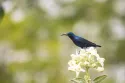
Measuring approximately 18 to 20 centimeters in length, the Bluish-fronted Jacamar is a compact yet striking bird that showcases the aesthetic brilliance of the Jacamar family. Its primary coloration is a vibrant, shimmering green that covers much of its upper body, providing excellent camouflage against the leafy canopy of its rainforest home. As its name suggests, the defining feature of the Galbula cyanescens is the patch of iridescent blue found on its forehead, which catches the light when the bird is in motion or displaying. The underparts often exhibit a rich rufous or cinnamon hue, creating a beautiful contrast against the metallic green of the back and wings. The species possesses a long, needle-like, black bill, which is perfectly adapted for capturing insects in mid-air. Both males and females share similar plumage, though subtle differences in the intensity of the blue or the shade of the underbelly can sometimes be observed. Their short legs and perching stance are typical of the order Galbuliformes, contributing to their aerodynamic efficiency and stability while waiting for prey to pass by.
Habitat
The Bluish-fronted Jacamar is primarily restricted to the western Amazon basin, inhabiting regions across parts of Peru, Brazil, and Bolivia. They favor humid lowland forests, particularly those found near river edges, forest gaps, and clearings where sunlight can penetrate the dense canopy. Unlike some forest birds that reside deep within the dark understory, the Bluish-fronted Jacamar prefers the mid-to-upper levels of the forest strata. By choosing these locations, they maintain a clear line of sight, allowing them to spot flying insects against the sky. Their habitat must provide a steady supply of perches, as the species spends a significant portion of its day sitting quietly, waiting for the perfect moment to launch into a swift aerial maneuver.
Diet
As an insectivore, the diet of the Bluish-fronted Jacamar consists almost exclusively of flying insects. Their hunting strategy is one of patient observation followed by explosive action. They remain motionless on a favorite branch until they detect movement, at which point they launch into a rapid, acrobatic flight to snatch the prey out of the air. Their diet is varied, including a wide array of butterflies, moths, dragonflies, and bees. The long, sharp bill is highly specialized, allowing them to handle even the most fragile or stinging insects with precision. Once caught, they often return to their perch to beat the prey against the branch, ensuring it is subdued before consumption.
Breeding and Nesting
Breeding for the Bluish-fronted Jacamar is a labor-intensive process that relies on the geological features of their environment. Unlike many birds that build nests in trees, these jacamars typically excavate nesting tunnels in vertical earthen banks, such as those found along riverbeds or road cuts. They use their specialized bills to dig deep into the soil, creating a safe chamber to protect their eggs and chicks from predators and the elements. Both parents participate in the excavation and the subsequent care of the brood. The clutch size is typically small, and the incubation period requires both parents to take turns. This unique nesting habit is a testament to their evolutionary adaptation, allowing them to thrive in competitive forest environments where tree-cavity nesting sites might be claimed by larger, more aggressive species.
Behavior
Behaviorally, the Bluish-fronted Jacamar is characterized by its solitary nature and extreme patience. They are rarely seen in large groups, preferring to spend their time alone or in mated pairs. Their movement is deliberate; they often remain perfectly still for long periods, which makes them easy to overlook despite their brilliant colors. When they do move, it is with sudden, high-speed energy during their hunting sorties. They are also known for their vocalizations, which are often high-pitched, whistled notes that can be heard across the forest canopy. During the breeding season, they may engage in aerial displays to signal territory or attract a mate, showcasing their agility and speed.
Conservation Status - LC Least Concern
The Bluish-fronted Jacamar is currently categorized as a species of Least Concern by the IUCN. However, this does not mean they are immune to the threats facing Amazonian wildlife. The primary danger to their population is the ongoing loss of habitat due to deforestation, logging, and agricultural expansion. Because they rely on specific forest structures and vertical earthen banks for nesting, any significant change to their local environment can disrupt their breeding cycle. Conservation efforts focused on protecting primary rainforest corridors are essential to ensuring that these vibrant perching birds continue to flourish in their natural tropical range.
Interesting Facts
- The name 'Jacamar' is derived from the Tupi language, meaning 'to eat a fly.'
- Their long, needle-like bills are specifically evolved to handle stinging insects like wasps and bees.
- Bluish-fronted Jacamars are known for their 'sit-and-wait' hunting strategy, remaining motionless for long periods.
- They are expert aerialists, capable of making sharp, sudden turns to capture agile insects.
- The blue patch on their forehead is a form of structural coloration, meaning it changes appearance based on the angle of light.
- They nest in tunnels dug into earthen banks rather than in trees.
Tips for Birdwatchers
For birdwatchers hoping to spot the Bluish-fronted Jacamar, patience is the ultimate virtue. Because they are sit-and-wait predators, you are far more likely to see them if you remain still near forest clearings or river edges. Scan the mid-to-high branches of trees that border these open spaces, as these are their preferred hunting perches. Use high-quality binoculars to look for the distinct iridescent blue on the forehead, which is the most reliable way to distinguish them from other jacamar species. Early morning and late afternoon are the best times to observe their activity. If you hear a series of high-pitched, piercing whistles, stop and scan the trees in the immediate vicinity, as these calls often precede a hunting flight.
Conclusion
The Bluish-fronted Jacamar is a true jewel of the Amazon, representing the complex and beautiful interplay between avian evolution and tropical ecology. From its striking metallic green plumage and signature blue forehead to its specialized, high-speed hunting techniques, this bird is a perfect example of how specialized species occupy unique niches in the rainforest. While they remain relatively common in their range, their dependence on intact forest ecosystems serves as a reminder of the fragility of our planet's biodiversity. For birdwatchers, encountering a Bluish-fronted Jacamar is a rewarding experience that requires patience, observation, and a deep appreciation for the quiet corners of the forest. As we continue to study and protect the western Amazon, the Bluish-fronted Jacamar will remain a focal point for those interested in the intricate lives of perching birds. By preserving the habitat they call home, we ensure that future generations can continue to marvel at this agile, colorful, and highly specialized hunter. Whether you are a professional ornithologist or a casual backyard enthusiast, learning about the Bluish-fronted Jacamar provides a window into the wonders of the natural world and the importance of conservation in sustaining the delicate balance of life in the tropics.