
Introduction
The Ruddy Kingfisher (Halcyon coromanda) is a stunning member of the Alcedinidae family, renowned for its striking, monochromatic plumage that sets it apart from the more common, multi-colored kingfishers. As a forest-dwelling species, this bird exhibits a shy and elusive nature, making it a prized sighting for ornithologists and bird enthusiasts across East and Southeast Asia. Unlike many of its relatives that are strictly associated with water, the Ruddy Kingfisher is primarily a woodland bird, often found far from permanent water bodies. Its name, derived from its deep, rust-like coloration, perfectly encapsulates its most recognizable feature. This species is migratory in the northern parts of its range, undertaking impressive journeys to reach its breeding grounds. Understanding the ecology and behavior of the Ruddy Kingfisher provides significant insight into forest health, as these birds serve as indicators of biodiversity in their respective environments. Their presence is a testament to the quality of the canopy and the richness of the insect life within their habitats.
Physical Appearance
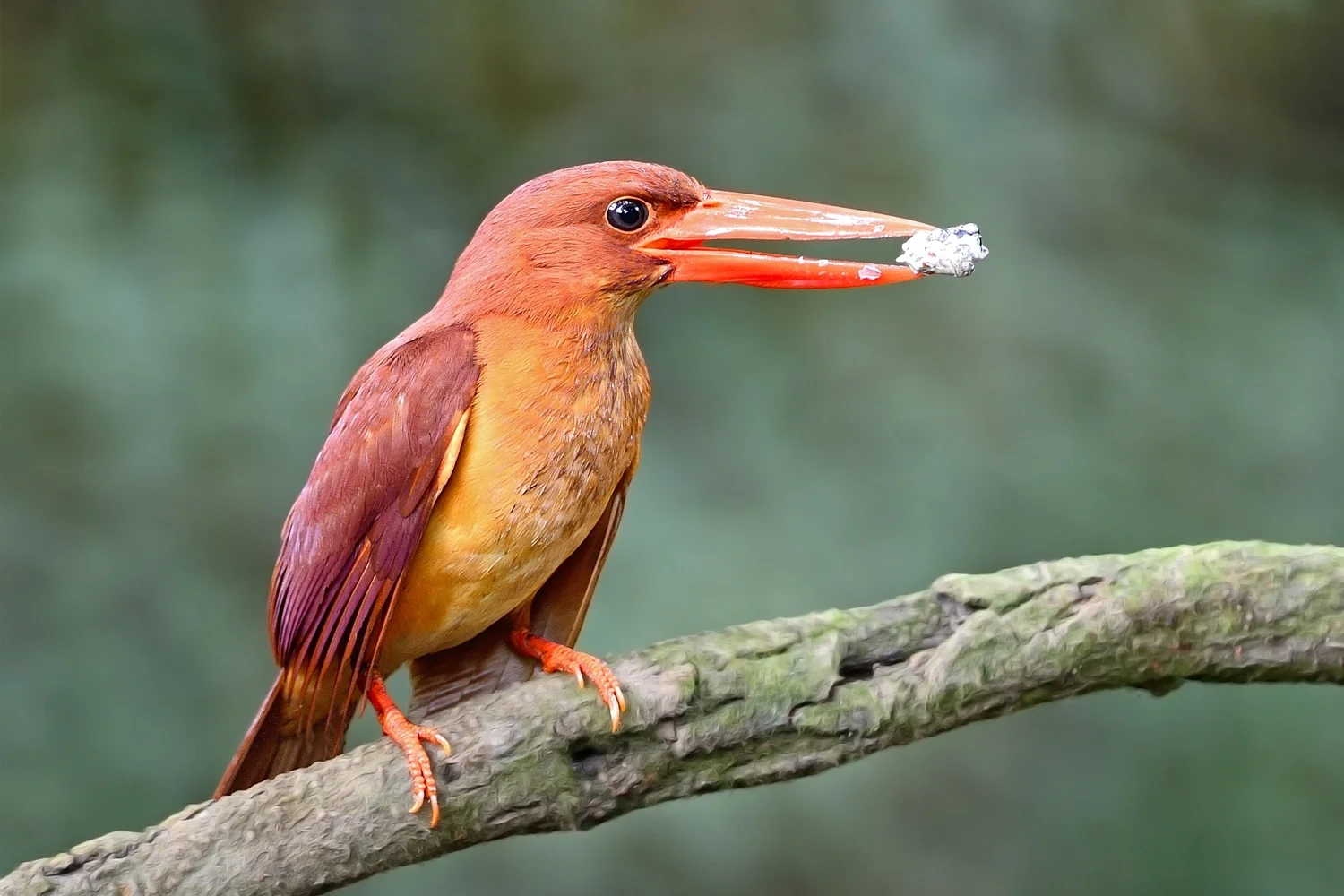
Measuring approximately 25 to 27 cm in length, the Ruddy Kingfisher is a medium-sized bird with a robust build. Its most defining characteristic is its intense, uniform red and rufous coloration, which covers the majority of its body. The mantle and wings often exhibit a deeper, more saturated reddish-brown tone, while the underparts are typically a lighter, warmer shade of rufous. A subtle, iridescent blue patch is often present on the lower back or rump, which catches the light during flight, creating a brief but spectacular flash of color. The bill is heavy, sharp, and bright red, perfectly adapted for grasping prey, while its legs and feet are also a matching vibrant red. The eyes are dark, providing a sharp contrast to the warm tones of its plumage. Juveniles generally appear duller than adults, with faint barring on the breast, but as they mature, they develop the brilliant, glowing coat that makes the adult Ruddy Kingfisher so iconic.
Habitat
The Ruddy Kingfisher is primarily a bird of dense, humid forests. Unlike the Common Kingfisher, which prefers riverbanks and lakes, the Ruddy Kingfisher thrives in subtropical and tropical evergreen forests, mangroves, and sometimes even in well-wooded gardens or plantations. They are typically found in the understory or mid-canopy levels, where the dense foliage provides both cover and hunting perches. Their distribution spans across parts of India, China, Japan, and Southeast Asia. During the breeding season, they favor locations with abundant insect life and soft earth or tree cavities that are suitable for excavation. As a migratory species, they may also be found in secondary forests and coastal scrub during their seasonal movements, provided there is sufficient shelter and food.
Diet
The diet of the Ruddy Kingfisher is diverse and primarily insectivorous, though it is opportunistic in its feeding habits. They are known to hunt large insects, including beetles, grasshoppers, cicadas, and mantises, which they snatch from the forest floor or foliage. In addition to insects, they frequently consume small crustaceans, such as crabs and shrimp, especially when foraging near small streams or damp forest patches. Occasionally, they will capture small reptiles like lizards or small amphibians, showcasing their versatility as predators. They typically hunt from a stationary perch, scanning the environment with intense concentration before diving down to strike their target with precision, returning to their perch to consume the catch.
Breeding and Nesting
The breeding season of the Ruddy Kingfisher is a fascinating display of territoriality and ingenuity. These birds are known to excavate their nests in unique locations, often choosing termite mounds located high up in trees or occasionally in soft riverbanks or tree hollows. Both the male and female participate in the nest excavation process, using their powerful bills to create a secure chamber that protects their eggs from predators. A typical clutch consists of three to six white, rounded eggs. Both parents are highly involved in the incubation process and the subsequent care of the chicks. They are fiercely protective of their nesting territory, often emitting loud, piercing calls to ward off intruders. Once hatched, the chicks are fed a steady diet of insects until they are ready to fledge, which usually occurs after several weeks of intensive parental care.
Behavior
The Ruddy Kingfisher is a solitary bird, often heard before it is seen. Its call is a loud, descending, and somewhat melancholy whistle that echoes through the forest canopy. They are notoriously shy and prefer to remain hidden within the dense vegetation, making them challenging to observe. During the breeding season, they become more vocal and active, often performing aerial displays to establish dominance or attract a mate. Despite their bright coloration, they are masters of camouflage, as their reddish-brown feathers blend remarkably well with the shadows and dead leaves of the forest floor, allowing them to remain undetected by both predators and potential observers.
Conservation Status - LC Least Concern
Currently, the Ruddy Kingfisher is listed as Least Concern by the IUCN. However, like many forest-dwelling species, they are vulnerable to habitat loss and degradation caused by deforestation, agricultural expansion, and urban development. Because they rely on specific types of forest structure for nesting and foraging, the fragmentation of their native environments poses a significant long-term risk. Conservation efforts should focus on protecting remaining old-growth forests and maintaining corridors that allow these migratory birds to move safely between their breeding and wintering grounds. Protecting the integrity of their ecosystem is essential for ensuring the survival of this beautiful avian species.
Interesting Facts
- The Ruddy Kingfisher is often called the 'Red Kingfisher' due to its distinct, vibrant plumage.
- Unlike many kingfishers, they are not strictly tied to water and can be found deep in inland forests.
- They have a unique habit of nesting inside active or abandoned arboreal termite mounds.
- Their sharp, red bill is perfectly evolved for hunting diverse prey like crabs and beetles.
- They are migratory birds, moving across vast distances between their breeding and wintering ranges.
- They possess a hidden, brilliant iridescent blue patch on their lower back that is only visible during flight.
- Their call is a distinctive, long, and descending whistle that can be heard from a significant distance.
Tips for Birdwatchers
For birdwatchers hoping to spot the elusive Ruddy Kingfisher, patience is the ultimate virtue. Because they are shy and prefer dense, shaded areas, the best approach is to find a quiet spot near a known habitat and remain still for an extended period. Early morning and late afternoon are the most active times for these birds. Listen carefully for their characteristic descending whistle, which is often the first clue to their presence. Using high-quality binoculars or a spotting scope is essential, as these birds often perch in the mid-canopy. If you are in a region where they nest, keep a respectful distance to avoid disturbing their breeding activities. Capturing a photo requires a fast shutter speed and a long lens, as these birds can be quite flighty when they sense movement.
Conclusion
The Ruddy Kingfisher is undoubtedly one of the most aesthetically pleasing and ecologically intriguing birds in the Asian wilderness. Its brilliant red and rufous plumage serves as a reminder of the incredible diversity found within the world's forest ecosystems. While they are not as widely seen as some of their more urban-adapted cousins, the effort required to observe a Ruddy Kingfisher in its natural habitat is incredibly rewarding. As we continue to navigate the challenges of environmental change, the preservation of the dense, healthy forests this bird calls home remains a priority. By understanding their needs, behavior, and the threats they face, we can better appreciate the complex role they play in their environment. Whether you are a seasoned ornithologist or a casual birdwatcher, the Ruddy Kingfisher remains a symbol of the wild, untamed beauty of the forest. We must continue to support habitat conservation to ensure that future generations can also witness the striking sight of this magnificent bird darting through the canopy. Always remember that the best way to enjoy these birds is through observation that respects their natural behavior and protects their fragile home.