
Introduction
The Brown Crake (Amaurornis akool) is a distinctive member of the Rallidae family. Known for its secretive yet occasionally bold nature, this waterbird is a common sight in the wetlands of South and East Asia. It belongs to the same family as rails and coots, sharing many of their aquatic adaptations.
Physical Appearance
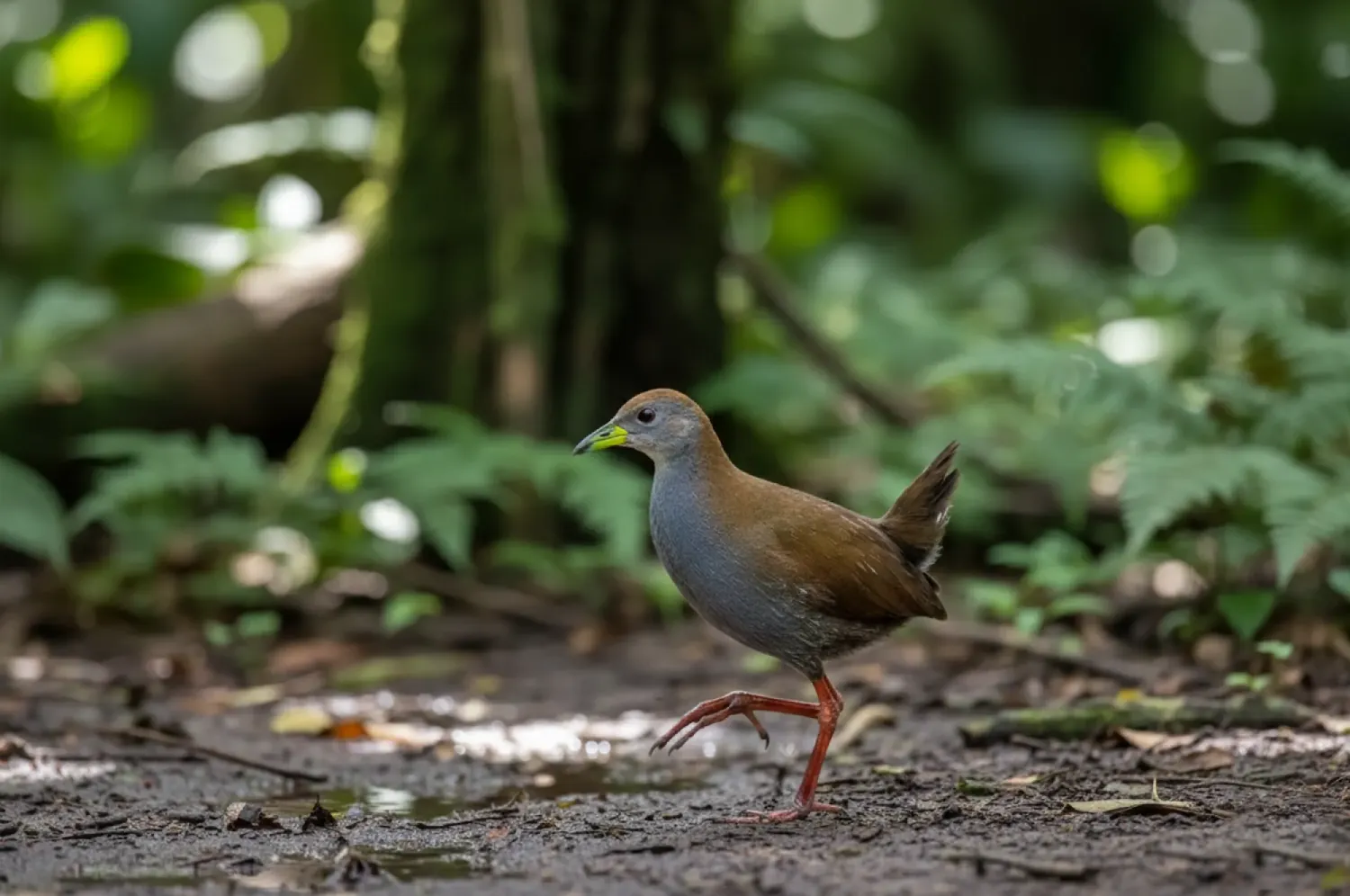
The Brown Crake is a medium-sized bird, typically measuring around 28 cm in length. It features uniform olive-brown upperparts and a contrasting slate-grey throat and breast. One of its most striking features is its pinkish-red legs and a greenish bill with a slight reddish tint at the base. Its short tail is often seen flicking as it walks.
Habitat
This species is primarily found in freshwater habitats. It frequents the edges of marshes, reed beds, and slow-moving streams. Unlike many other crakes, the Brown Crake is also known to inhabit rocky areas and scrublands that are in close proximity to water sources, such as irrigation canals and village ponds.
Diet
The Brown Crake is an omnivore with a diet consisting mainly of insects, worms, and small mollusks. It forages by probing the mud or picking items off the water's surface. Additionally, it consumes seeds and various types of aquatic vegetation to balance its nutritional intake.
Breeding and Nesting
Breeding usually coincides with the rainy season. The Brown Crake constructs a cup-shaped nest made of grass, weeds, and reeds. These nests are typically placed in dense vegetation or low bushes near the water to protect the 5 to 7 eggs from predators.
Behavior
While it can be shy, the Brown Crake is generally less skittish than other crake species. It is often observed foraging in the open on muddy banks during the early morning or late evening. When disturbed, it prefers to run into thick cover rather than fly, though it is a capable swimmer.
Conservation Status - LC Least Concern
The Brown Crake is currently listed as Least Concern by the IUCN. While the population is considered stable, the species faces ongoing threats from habitat destruction, wetland drainage, and water pollution in its native range.
Interesting Facts
- The scientific name 'akool' is thought to be derived from a local Indian name or Hindu mythology.
- Unlike many of its relatives, the Brown Crake is frequently seen in pairs or small family groups rather than being strictly solitary.
- They possess a loud, vibrating trill that is most commonly heard during the dawn and dusk periods.
Tips for Birdwatchers
- Focus your search on rocky stream banks and thick reed edges where they like to hide.
- Patience is key; wait quietly near a water source during the golden hours of sunrise or sunset.
- Use binoculars to scan the mudline for their bright pinkish-red legs, which often stand out against dark mud.
Conclusion
The Brown Crake is a fascinating species that adds character to the wetland ecosystems of Asia. For birdwatchers, spotting this olive-brown beauty foraging along a stream is a rewarding experience that highlights the biodiversity of freshwater habitats.
