
Introduction
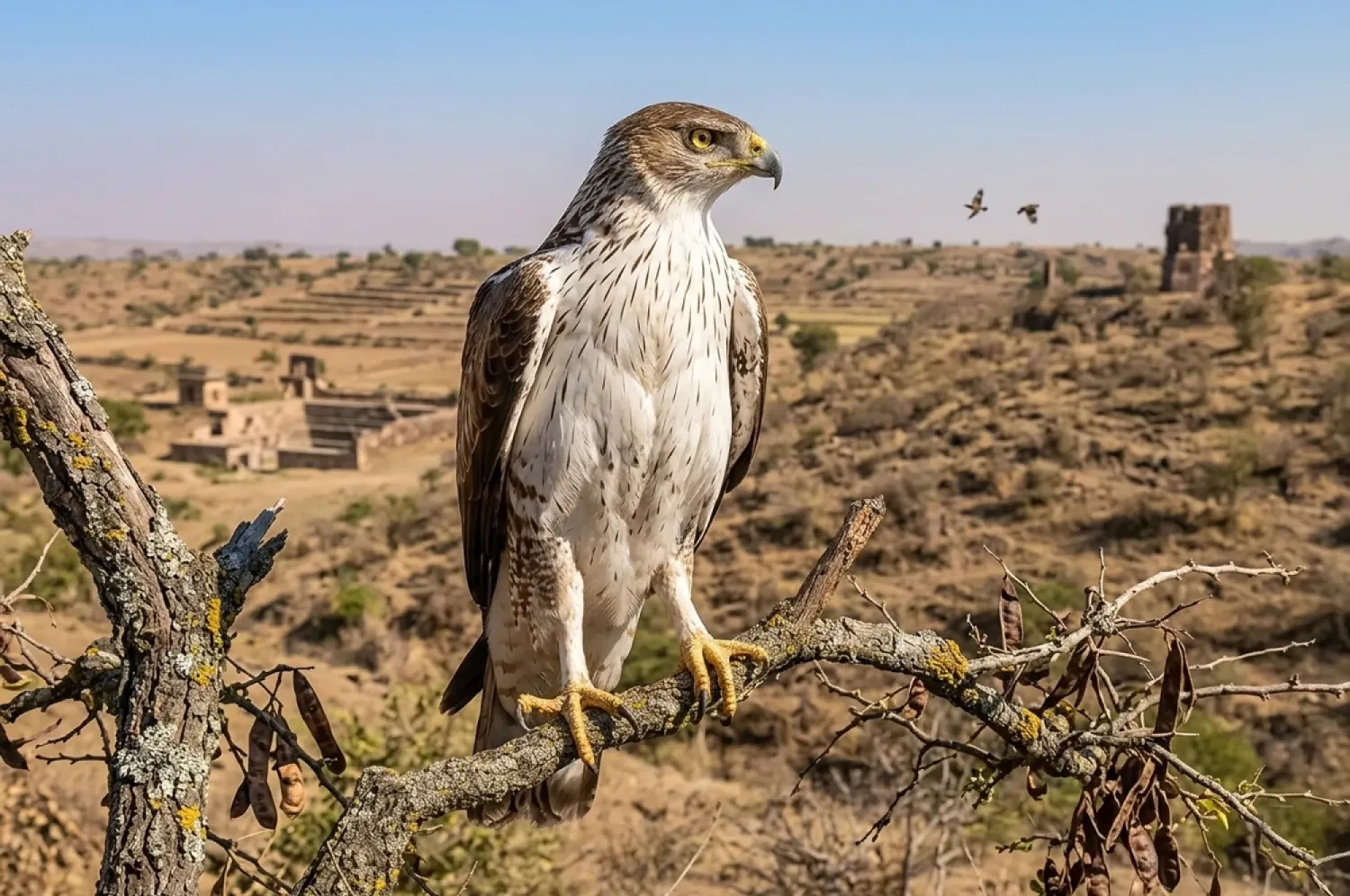
The Bonelli's Eagle (Aquila fasciata) is a powerful and agile bird of prey native to Southern Europe, Africa, and parts of Asia. Named after the Italian ornithologist Franco Andrea Bonelli, this raptor is celebrated for its impressive hunting skills and striking presence in rugged landscapes.
Physical Appearance
This medium-to-large eagle typically measures between 65-72 cm in length with a wingspan of 150-180 cm. Adults feature a dark brown back and a distinctive white underside heavily streaked with dark brown. One of its most identifying marks is a small white patch on its back, visible during flight.
Habitat
The Bonelli's Eagle thrives in hilly or mountainous terrain, particularly in Mediterranean climates. They prefer open landscapes with cliffs and crags for nesting, often avoiding densely forested areas in favor of scrublands and arid regions where visibility is high.
Diet
As a formidable apex predator, the Bonelli's Eagle has a diverse diet. Its primary food sources include:
- Small mammals: Primarily rabbits, hares, and squirrels.
- Birds: Pigeons, partridges, and occasionally larger waterbirds.
- Reptiles: Large lizards are often taken in warmer regions.
Breeding and Nesting
Breeding pairs are usually monogamous and highly territorial. They build massive stick nests, known as eyries, typically located on steep cliff ledges or occasionally in tall trees. A clutch usually consists of two eggs, which are incubated for approximately 37 to 41 days.
Behavior
This species is known for its incredible speed and maneuverability. Unlike many larger eagles that scavenge, the Bonelli's Eagle is an active hunter that often hunts in pairs. One bird may flush the prey while the other strikes, demonstrating a high level of coordination.
Conservation Status - LC Least Concern
While globally listed as Least Concern by the IUCN, many regional populations—especially in Western Europe—are considered endangered. Major threats include habitat fragmentation, electrocution from power lines, and illegal persecution.
Interesting Facts
- The Bonelli's Eagle can reach speeds of over 100 km/h during a hunting dive.
- They have exceptionally strong feet and talons relative to their body size, allowing them to take down prey larger than themselves.
- They are known to maintain multiple nests within their territory, switching between them in different years.
- Young eagles disperse over long distances before establishing their own territory.
Tips for Birdwatchers
To spot a Bonelli's Eagle, focus your search on rocky escarpments and canyons. They are most active during the mid-morning when they use thermal updrafts to soar. Look for their pale underparts and dark underwing coverts to distinguish them from other large raptors.
Conclusion
The Bonelli's Eagle is a magnificent symbol of wild, rocky ecosystems. Understanding its needs and protecting its nesting sites is essential for ensuring that this agile predator continues to soar across our skies for generations to come.
