
Introduction
The Common Stonechat (Saxicola torquatus) is a small, insectivorous passerine bird that has long fascinated ornithologists and birdwatchers alike. While historically treated as a single species, modern genetic research identifies it as a superspecies—a complex group of related but distinct species that replace one another geographically. Known for its upright posture and characteristic 'clicking' call, this bird is a staple of open landscapes.
Physical Appearance
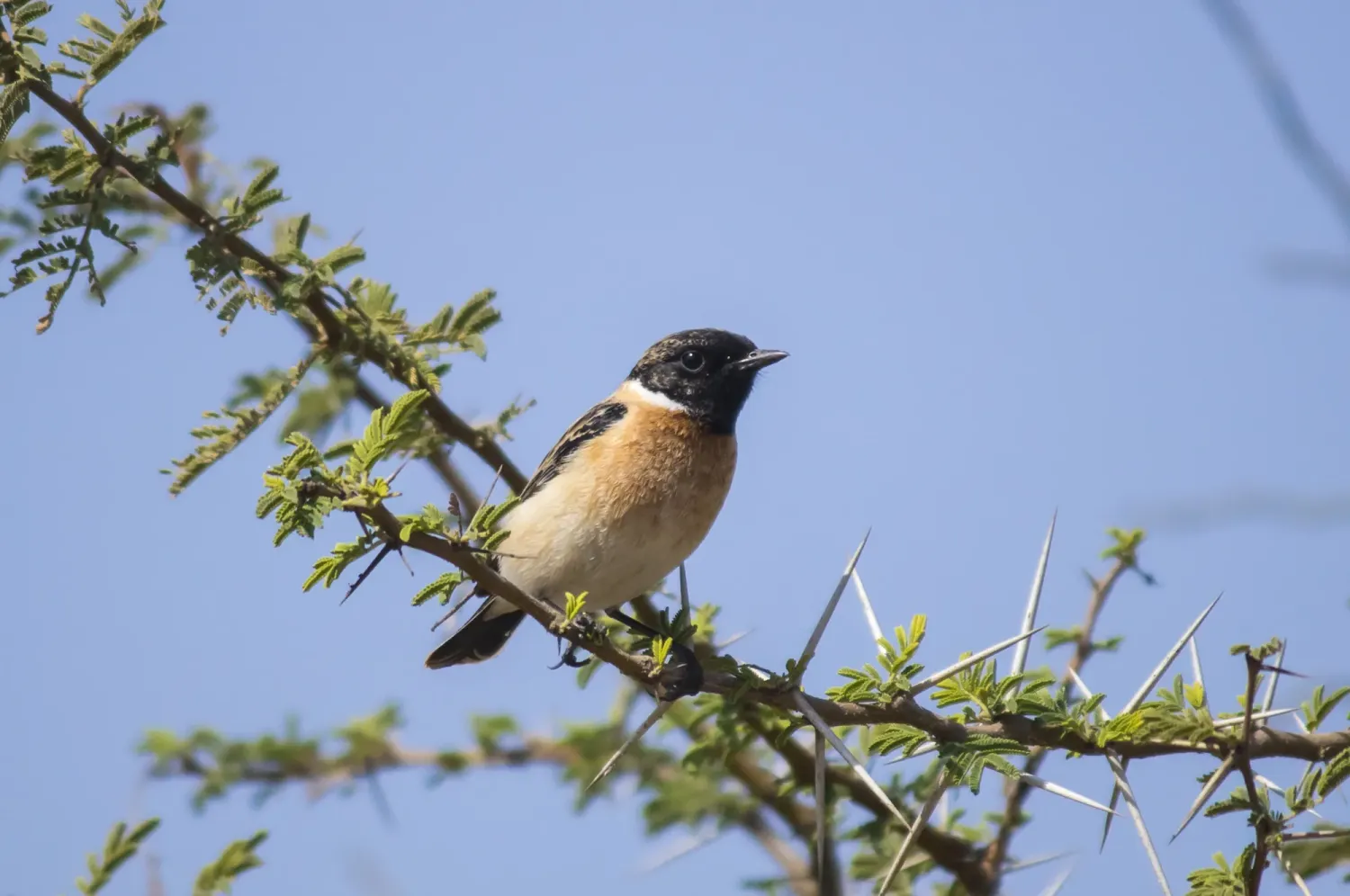
The Common Stonechat is a compact bird, typically measuring between 12 to 13 cm in length. It is often compared to its close relative, the European Stonechat, but can be distinguished by specific plumage details. It is generally darker above and paler below, featuring a prominent white rump and whiter underparts with less intense orange coloration on the breast than its relatives.
Habitat
These birds exhibit versatile habitat preferences depending on the season:
- Summer: They prefer open country punctuated with bushes, and are even found in high-altitude semi-desert regions.
- Winter: They move into lower-lying scrublands and areas of cultivation, where foraging remains viable during colder months.
Diet
The Common Stonechat is primarily an invertivore, though its diet is impressively varied. Its main food sources include:
- Invertebrates: Insects and larvae (beetles, flies, ants, grasshoppers, and bugs), damselflies, and spiders.
- Small Prey: Snails, small earthworms, and occasionally small fish or lizards.
- Plant Matter: During certain seasons, they will also consume seeds and various fruits.
Breeding and Nesting
Nesting typically occurs in dense, low vegetation. The female constructs a cup-shaped nest made of grass, roots, and moss, often lining it with hair or feathers. These nests are strategically hidden at the base of bushes or within thick tufts of grass to provide protection from predators. The species is known for its territorial nature during the breeding season.
Behavior
One of the most identifiable traits of the Common Stonechat is its habit of perching on the very top of bushes or fence posts to survey its territory. From these vantage points, it drops to the ground to snatch prey before returning to a perch. It frequently flicks its wings and tail, often accompanied by a sharp, metallic call that sounds like two stones being tapped together.
Conservation Status - LC Least Concern
The Common Stonechat is currently categorized as Least Concern by the IUCN. Because it is a superspecies with a vast geographic range, its overall population remains stable. However, localized populations can be sensitive to habitat loss caused by intensive agricultural practices and the clearing of scrubland.
Interesting Facts
- The Common Stonechat is part of a 'superspecies' complex, meaning different populations are genetically distinct despite looking very similar.
- Its scientific name, Saxicola, comes from the Latin 'saxum' (rock) and 'incola' (dweller).
- Unlike many small songbirds, they have been recorded eating small vertebrates like lizards and tiny fish.
- They are highly territorial and will vigorously defend their chosen perch from intruders.
Tips for Birdwatchers
To spot a Common Stonechat, look for a small bird sitting conspicuously on the highest point of a bush or wire. They are not particularly shy, making them excellent subjects for wildlife photography. Listen for their 'tacc-tacc' call, which is a surefire giveaway of their presence in open fields or coastal scrub.
Conclusion
With its striking plumage and bold personality, the Common Stonechat is a highlight of any birding trip. Understanding its complex genetic history and diverse dietary habits only adds to the intrigue of this resilient little bird. Whether in high-altitude deserts or local farmlands, the stonechat remains a vital part of its ecosystem.