
Introduction
The Scaly-breasted Munia (Lonchura punctulata), also frequently known as the Nutmeg Mannikin or Spice Finch, is a small and charming perching bird. Originally native to tropical Asia, this social species has successfully established itself in various parts of the world, becoming a common sight in gardens and agricultural lands.
Physical Appearance
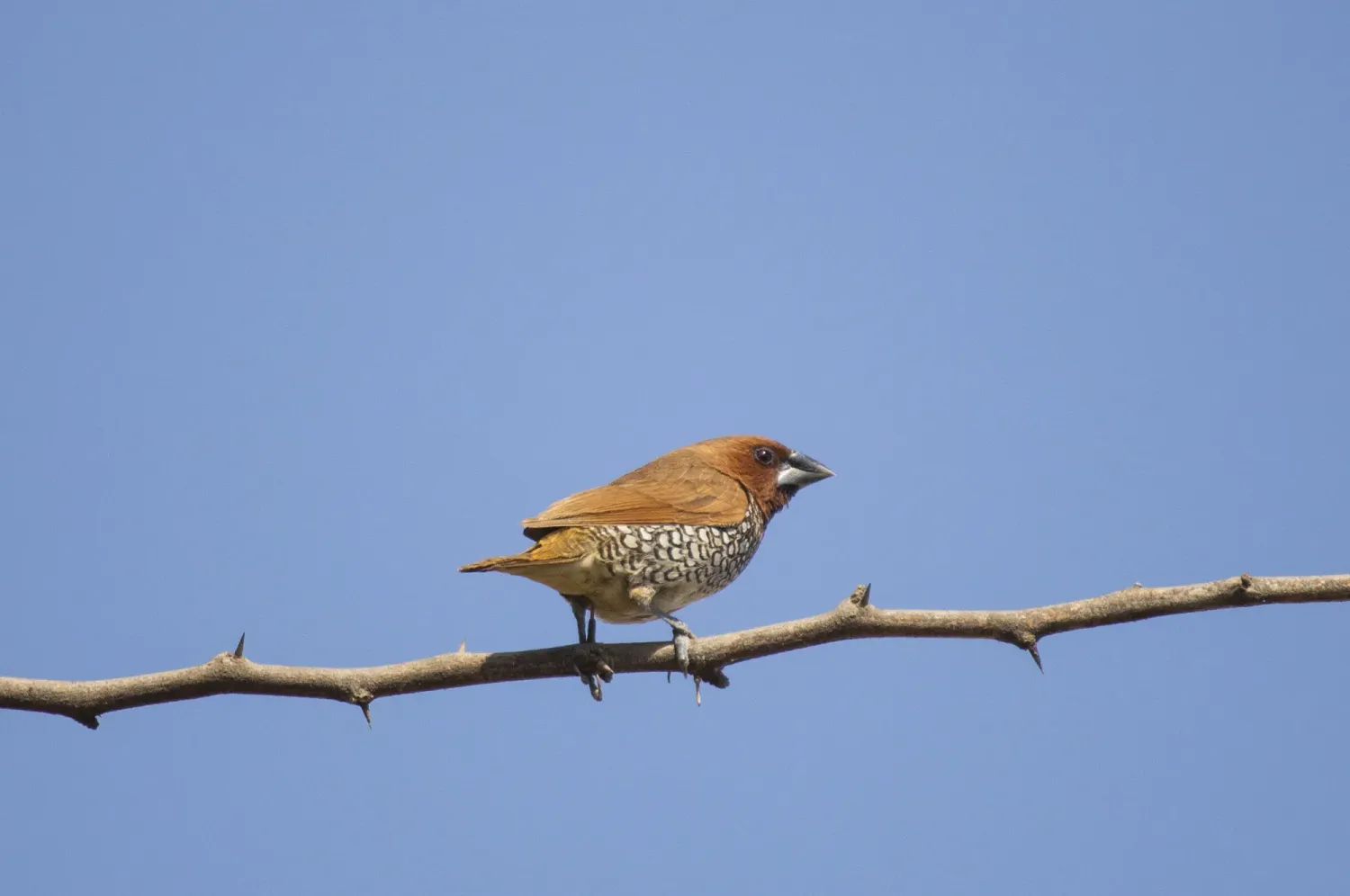
Measuring approximately 11-12 cm in length, the Scaly-breasted Munia is easily identified by its stubby dark bill and rich brown upperparts. The most striking feature of the adult is its white underparts, which are covered in distinctive black scale-like markings. While males and females look similar, immature birds are paler brown and lack the characteristic scales, possessing uniform buff underparts instead.
Habitat
This species is highly adaptable and prefers open secondary forests, bushes, and cultivation. They are particularly widespread in lowland agricultural areas. In their introduced ranges, such as Puerto Rico and Australia, they are frequently found in suburban environments and grassy woodlands.
Diet
The diet of the Scaly-breasted Munia consists mostly of seeds, which they forage for in grasses and on the ground. They are also known to occasionally consume berries and small insects to supplement their nutritional needs.
Breeding and Nesting
These birds build a large, domed nest constructed primarily of grass. These structures are typically placed securely in a tree or sometimes even under the eaves of houses. A typical clutch consists of 4 to 10 white eggs.
Behavior
The Scaly-breasted Munia is a gregarious bird, meaning it prefers the company of others. They are often seen in large flocks, sometimes consisting of fifteen or more individuals. They are active during the day and have become well-known for visiting suburban bird feeders in regions like Orange County, California.
Conservation Status - LC Least Concern
Due to its wide distribution and ability to thrive in human-altered landscapes, the Scaly-breasted Munia is generally considered a species of Least Concern. Its populations are stable and expanding in several introduced territories.
Interesting Facts
- In Puerto Rico and Hispaniola, these birds are locally known by the name pechijabao.
- They have successfully colonized the east coast of Australia, ranging from north of Townsville to south of Sydney.
- Their common name 'Nutmeg Mannikin' refers to the spice-colored plumage on their head and back.
- They are highly social and are rarely seen alone, preferring to forage and roost in groups.
Tips for Birdwatchers
- Look for them in grassy fields or near agricultural sites where seeds are abundant.
- Listen for their soft, short whistling calls to locate a flock hidden in the bushes.
- In Southern California, keep an eye on backyard bird feeders, as they are frequent visitors.
- Use a field guide to distinguish juveniles from other similar species, as they lack the adult's scaly chest.
Conclusion
With its unique scale-like patterns and social nature, the Scaly-breasted Munia is a fascinating bird to observe. Whether in its native Asian home or its new habitats across the globe, this resilient little finch continues to thrive alongside human cultivation and suburban development.