
Introduction
The Shikra (Accipiter badius), also known as the little banded goshawk, is a resilient and widely distributed bird of prey. Found across various landscapes in Asia and Africa, this small raptor belongs to the family Accipitridae and is celebrated for its agility and sharp hunting skills.
Physical Appearance
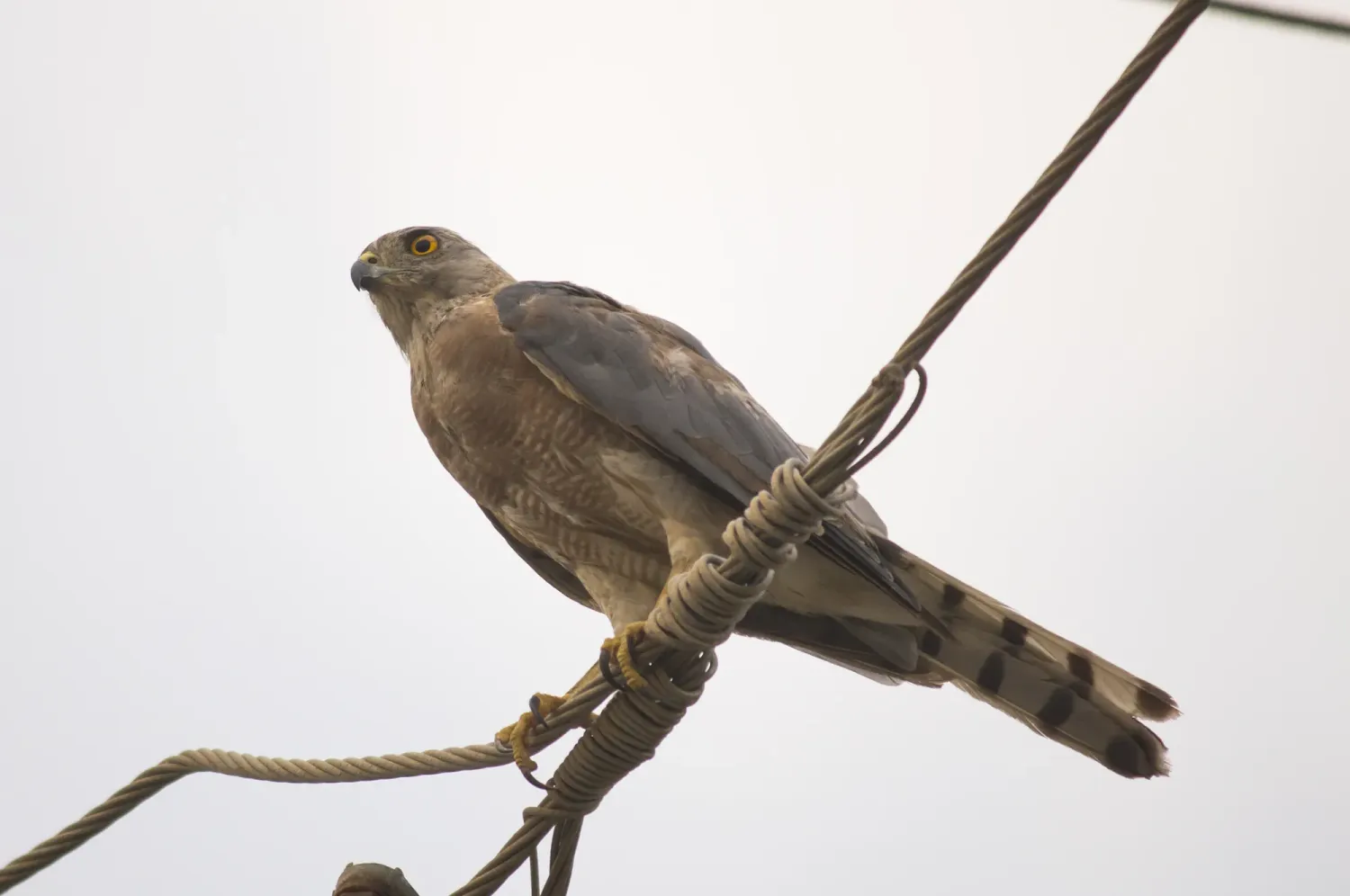
The Shikra is a small hawk, typically measuring 26 to 36 cm in length. It features short, rounded wings and a narrow, long tail. Adults have grey upperparts and whitish underparts with fine rufous bars. Males are distinguished by their red irises, while females possess yellowish-orange eyes and are slightly larger with heavier barring. Juveniles exhibit dark streaks and spots on the breast with narrow tail bands.
Habitat
The Shikra is highly adaptable, inhabiting forests, deciduous woodlands, plains, and farmlands. It is also frequently spotted in savannas, arid steppes, and even urban areas where gardens and parks provide sufficient cover and hunting grounds.
Diet
This raptor has a diverse diet and is a master of the surprise attack. Its primary food sources include:
- Lizards and geckos
- Small birds, nestlings, and eggs
- Rodents and bats
- Frogs and various insects
Breeding and Nesting
Shikras typically build their nests in tall trees, often using sticks and twigs lined with fine grass. They are known for their protective nature over their nesting sites. The breeding season varies by region, but they generally lay a clutch of 3 to 4 pale bluish-white eggs which are incubated primarily by the female.
Behavior
The Shikra exhibits a typical flap and glide flight pattern. It is known for its sharp two-note call, usually described as a pee-wee. They are territorial birds and are often seen perched high on a branch or wire, scanning the ground for movement. Interestingly, their calls are so distinct that they are often imitated by drongos.
Conservation Status - LC Least Concern
The Shikra is currently classified as Least Concern by the IUCN. Due to its wide distribution and ability to adapt to human-altered environments, such as urban parks and agricultural lands, its population remains stable across most of its range.
Interesting Facts
- The Shikra's calls are often imitated by Drongos to trick other birds into leaving food.
- The common hawk-cuckoo mimics the Shikra's plumage to avoid being attacked by smaller birds, a form of Batesian mimicry.
- In historical times, Shikras were popular in falconry because they were easy to train for hunting small game.
- The African forms of the Shikra are sometimes considered a separate species, though they are currently listed as subspecies.
Tips for Birdwatchers
To spot a Shikra, look for them perched on telephone wires or high tree branches in suburban parks. Listen for their distinct two-note call, which is a giveaway of their presence. They are most active during the early morning and late afternoon. Using high-quality binoculars will help you distinguish their fine rufous barring from other similar sparrowhawk species.
Conclusion
The Shikra is a fascinating example of avian adaptability. Whether in a dense forest or a bustling city, this little banded goshawk continues to thrive, making it a favorite subject for bird enthusiasts and wildlife photographers worldwide.