
Introduction
The black stork (Ciconia nigra) is a large, elusive bird belonging to the stork family Ciconiidae. First described by Carl Linnaeus in his 10th edition of Systema Naturae, this species is celebrated for its striking appearance and solitary nature, contrasting sharply with its more social relative, the white stork.
Physical Appearance
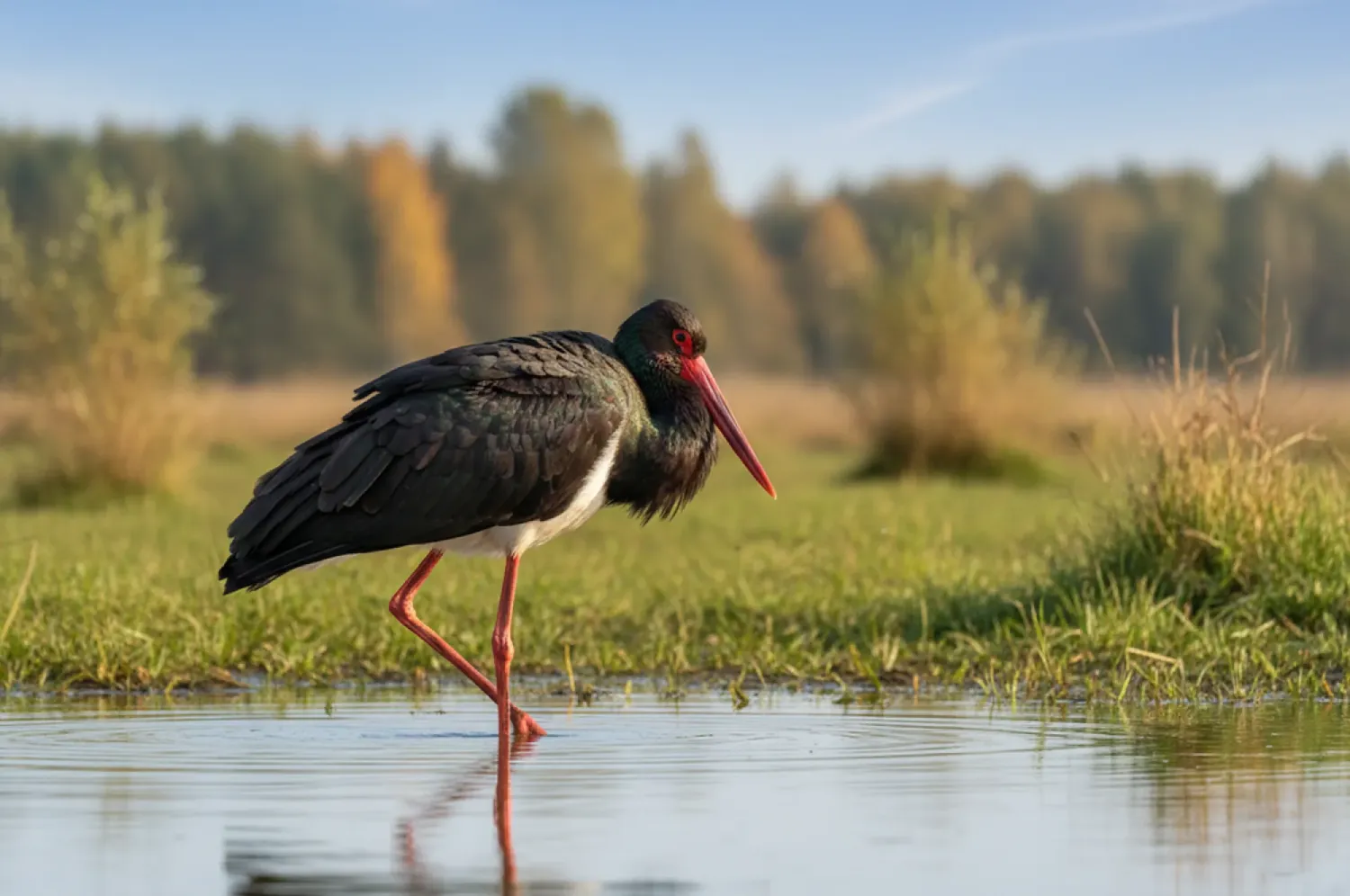
The adult black stork is a magnificent sight, measuring between 90-100 cm in length with a wingspan of 145-155 cm. It features predominantly black plumage with an iridescent purple and green sheen. These dark feathers are offset by a stark white belly, long red legs, and a long, pointed red beak that is characteristic of the species.
Habitat
Unlike many other storks, the black stork seeks seclusion. Its preferred habitat includes inland freshwaters such as marshes, rivers, and undisturbed deciduous or coniferous forests. They are typically found in areas where they can forage in shallow water, away from human interference and dense settlements.
Diet
The black stork is primarily a carnivore with a diverse diet. It mainly eats fish, including small cyprinids, pikes, eels, and muddy loaches. Additionally, it may feed on:
- Amphibians: Frogs and toads.
- Small Vertebrates: Reptiles, mammals, and occasionally small birds.
- Invertebrates: Snails, molluscs, earthworms, and water beetles.
Breeding and Nesting
Breeding pairs usually build large nests in forest trees or on large boulders and cliff ledges. The female typically lays two to five greyish-white eggs. Both parents share the incubation duties, which last 32 to 38 days, and the young birds fledge after 60 to 71 days.
Behavior
The black stork is a shy and wary species, often seen alone or in pairs. It forages by walking with measured strides in shallow water, stalking its prey with precision. As a long-distance migrant, it avoids crossing the Mediterranean Sea, instead detouring via the Levant or the Strait of Gibraltar to reach wintering grounds in Africa and India.
Conservation Status - LC Least Concern
Currently categorized as Least Concern by the IUCN, the black stork's status is somewhat uncertain due to its wide but scattered range. While populations are increasing in the Iberian Peninsula, they are declining in parts of China and India. It is protected under the African-Eurasian Waterbird Agreement (AEWA) and CITES.
Interesting Facts
- The black stork is much more secretive and solitary than the common white stork.
- During migration, they prefer land-based routes to avoid the thermal-less air over large bodies of water.
- An isolated, non-migratory population of black storks exists in Southern Africa.
- Their nests are often reused for many years, becoming quite massive over time.
Tips for Birdwatchers
To observe a black stork, patience is key. Visit remote wetlands or quiet riverbanks during the early morning. Because they are easily spooked, use high-quality binoculars or a spotting scope to maintain a respectful distance. Look for their distinctive red legs and deliberate walking pace in shallow water.
Conclusion
The black stork remains one of the most enigmatic birds of the forest and wetland. By understanding its unique needs and protecting its secluded habitats, we can ensure that this beautiful, shy migrant continues to grace our skies and waterways for generations to come.