
Introduction
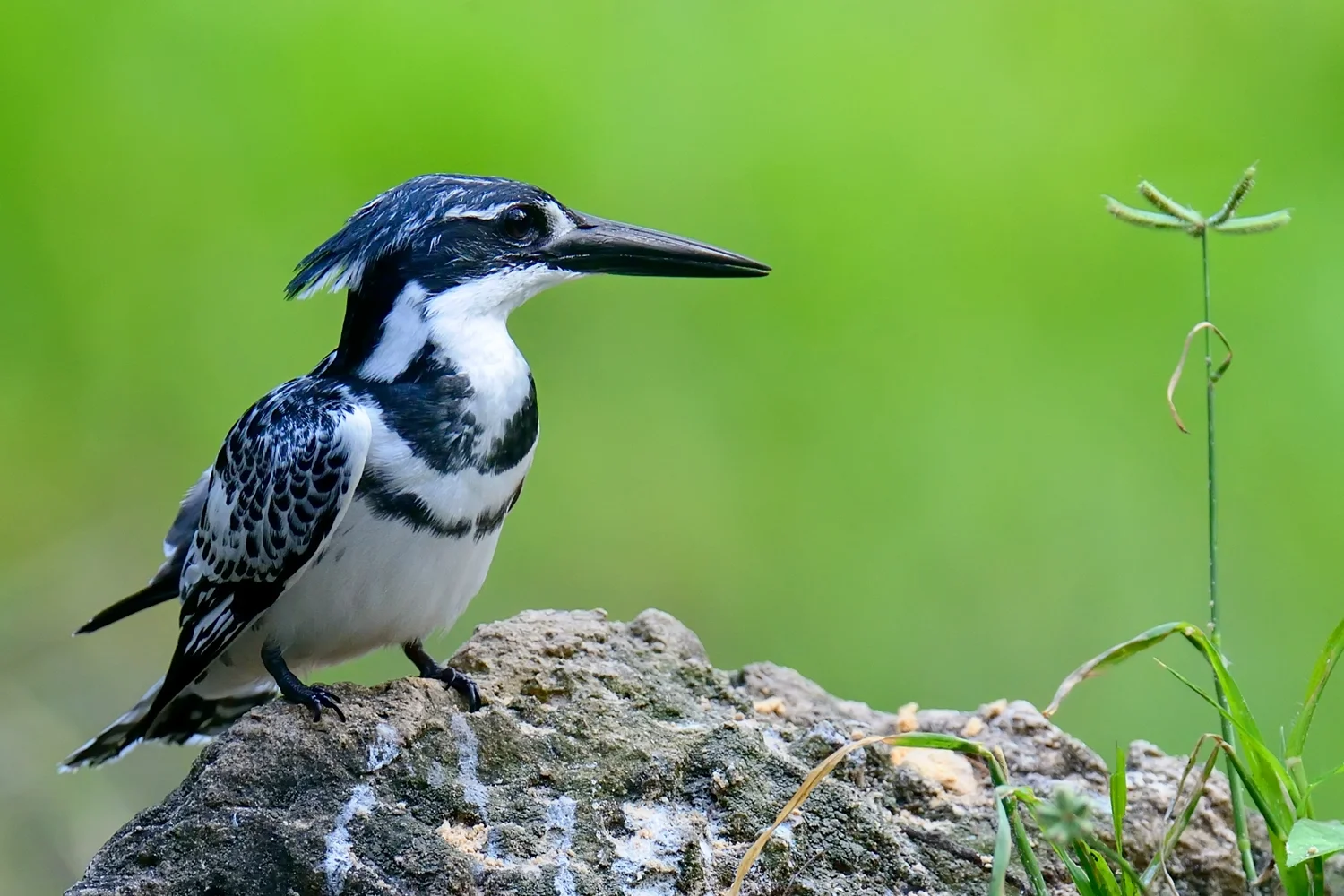
The Pied Kingfisher (Ceryle rudis) is one of the most widely distributed and easily recognizable kingfishers in the world. Found throughout Africa and Asia, this striking black and white bird is a master of the waterways, famous for its unique ability to hunt without a perch.
Physical Appearance
Measuring approximately 25 cm in length, the Pied Kingfisher features a distinctive black and white plumage. It sports a neat crest, a black mask, and a white supercilium. Males and females can be distinguished by their breast bands; males have two bands while females typically have one broken band. Their upperparts are intricately barred in black.
Habitat
This species is strictly tied to water. Its habitat includes large rivers, estuaries, lakes, coastal lagoons, and even rocky or sandy coasts. While it utilizes perches like trees, fences, and posts, it is unique among kingfishers for its ability to thrive in open water environments that lack traditional perching spots.
Diet
The Pied Kingfisher feeds primarily on fish, but its diet also includes crustaceans and large aquatic insects like dragonfly larvae. It is renowned for its hunting technique: hovering steadily over clear water to detect prey before diving vertically, bill-first, to make a catch.
Breeding and Nesting
The breeding season typically occurs from February to April. They excavate nest tunnels in vertical mud banks, usually about five feet above the water level. These tunnels can be 4 to 5 feet deep, ending in a nesting chamber. A clutch usually consists of 3-6 white eggs. Interestingly, they often practice cooperative breeding, where non-breeding birds help the parents raise the young.
Behavior
Unlike many other kingfisher species, the Pied Kingfisher is quite gregarious. They often form large communal roosts at night. Their flight is straight and rapid when not foraging. One of their most impressive behavioral traits is the ability to swallow prey while in flight, allowing them to hunt over vast bodies of water.
Conservation Status - LC Least Concern
Currently, Pied Kingfisher populations are not threatened. They remain one of the most widespread kingfisher species globally, showing resilience in various aquatic environments across two continents.
Interesting Facts
- It is the only kingfisher that can hunt in both fresh and salt water.
- They can deal with prey without returning to a perch, a rare trait among kingfishers.
- Pied Kingfishers are known to engage in cooperative breeding with "helpers" at the nest.
- In some regions like India, their nests are unfortunately prone to maggot and leech infestations.
- They are the largest of the "hovering" kingfishers.
Tips for Birdwatchers
To spot a Pied Kingfisher, look for them hovering stationary over lakes or rivers. They are very vocal and active during the day. Visit estuaries or large dams during the early morning for the best photography opportunities, as they are often less shy than other kingfisher species.
Conclusion
The Pied Kingfisher is a remarkable avian predator that combines striking aesthetics with specialized hunting skills. Whether you are in Africa or Asia, watching this bird hover and dive is a highlight for any birdwatcher or nature enthusiast.