
Introduction
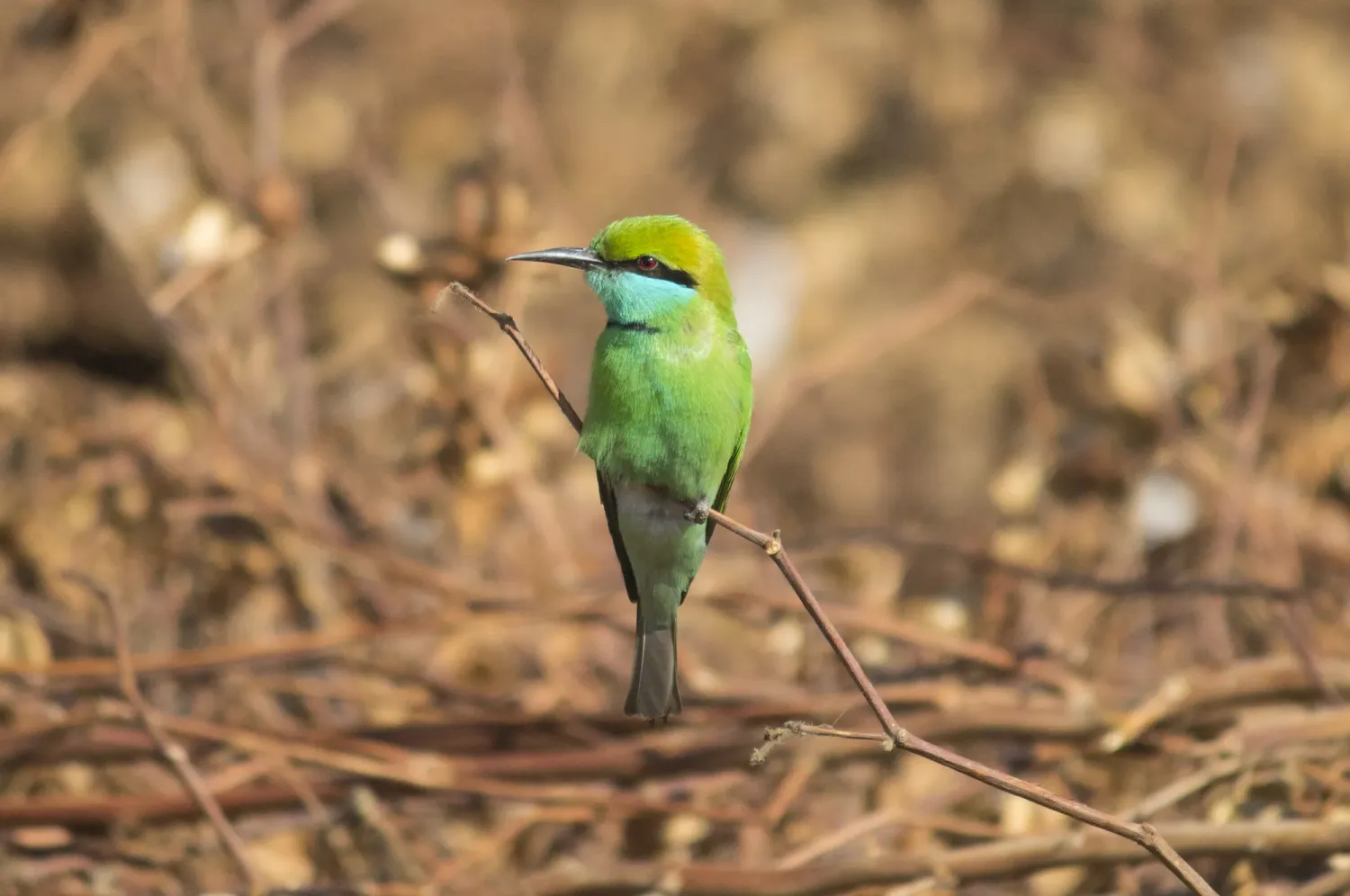
The Green Bee-eater (Merops orientalis), also frequently referred to as the little green bee-eater, is a striking near-passerine bird belonging to the bee-eater family. Known for its vivid colors and graceful flight, this species is a favorite among birdwatchers across its wide range in sub-Saharan Africa and Asia.
Physical Appearance
This species is a richly coloured, slender bird measuring approximately 16-18 cm in length. Its most distinctive features include its bright green plumage, often tinged with blue on the chin and throat, and elongated central tail-feathers that add about 2 inches to its length. The crown and upper back typically have a golden rufous tint, while a sharp black line runs through the eye. Juveniles can be identified by the absence of the long tail streamers.
Habitat
The Green Bee-eater is highly adaptable, inhabiting wooded areas with scattered trees, arid regions with Acacia and date palms, and even large gardens or cultivated lands. They are particularly fond of sandy and bare soils and can be found at various elevations, ranging from sea level up to 2,000 metres.
Diet
As their name suggests, these birds are primarily insectivores. Their diet consists of:
- Hymenoptera: Bees and wasps.
- Beetles and Bugs: Various hard-shelled insects.
- Flying Insects: Moths, flies, butterflies, and dragonflies.
- Other: Spiders, crickets, and caterpillars.
Breeding and Nesting
Unlike some other more social bee-eater species, the Green Bee-eater is often less gregarious when it comes to nesting. They may nest alone or in small groups, typically choosing sandy or bare soils to create their burrows, which provides safety for their offspring.
Behavior
These birds are known for their unique hunting style; they hunt from low perches such as fences or small trees, performing short swoops to catch prey before returning to the same spot. Before swallowing a stinging insect, the bird will strike it against a hard surface several times to remove the dart or stinger. While they hunt alone, they are known to roost in large flocks high in trees at night.
Conservation Status - LC Least Concern
The Green Bee-eater is currently classified as Least Concern by the IUCN, thanks to its extremely wide distribution and stable population trends across Africa, the Middle East, and Southeast Asia.
Interesting Facts
- The Green Bee-eater is a master of 'stinger removal,' expertly de-poisoning bees before eating them.
- They have been observed perching on the backs of grazing cattle or antelopes to catch insects disturbed by the animals.
- Their feet are relatively weak, with three toes joined at the base, adapted more for perching than walking.
- Regional variations exist, such as Southeast Asian birds having more rufous on their crowns compared to Arabian populations.
Tips for Birdwatchers
To spot a Green Bee-eater, look for them along fence lines and low-hanging branches near open grasslands or water sources. They are often found in pairs or small groups during the day. Listen for their soft, trilling calls, and watch for their distinctive 'sallying' flight pattern where they loop out to catch an insect and return to the exact same perch.
Conclusion
The Green Bee-eater is a testament to the beauty of the avian world, combining vibrant aesthetics with fascinating survival behaviors. Whether in a desert dune or a lush garden, these birds remain a vital part of their ecosystem by controlling insect populations and providing a splash of color to the landscape.